

Stone Bathtub: Types, Colours and How to Choose One
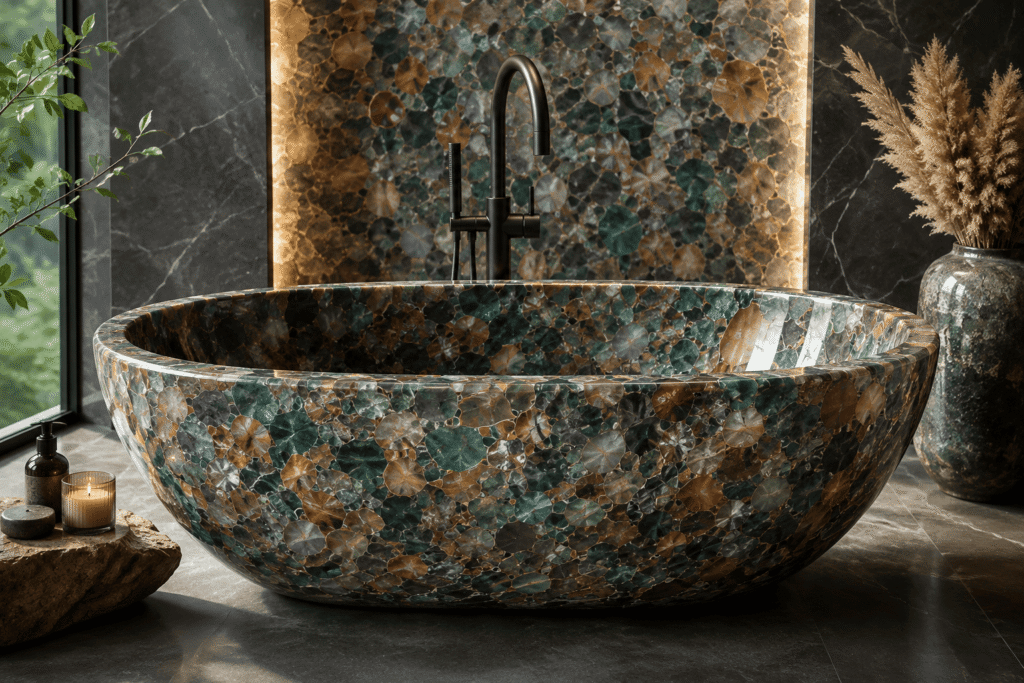
A stone bathtub turns an ordinary bathroom into a place people remember. Unlike acrylic or ceramic, a stone bath is cut from natural stone, so its colour, banding and crystal patterns are never repeated. This guide explains the main types of stone bathtub, the colours available, how to choose one for your bathroom, what affects the price and how to look after it.
It is written by the Subh Gem Stones team, who manufacture natural stone bathtubs and bathtub surrounds in Kishangarh, Rajasthan, and supply them across India and to 25 countries.
What Is a Stone Bathtub?
A stone bathtub is a bathtub, or a bathtub surround, made from natural stone slabs that are cut, shaped, polished and finished for wet area use. Some baths sold as stone are cast from resin mixed with crushed stone. A natural stone bath is different, because the surface is real stone and every piece carries its own pattern.
Stone baths fall into two broad groups. A freestanding bath is a complete form that stands on its own, while a stone bathtub surround clads the deck, walls and sides of a bath with stone slabs. At Subh Gem Stones, both are made from semi precious stones such as agate, quartz, amethyst, jasper and petrified wood. These are our gemstone bathtubs, and you can see the full range on our gemstone bathtub options page.
Types of Stone Bathtubs by Stone
Each stone family gives a different look and asks for slightly different care. Here is how they compare, with the varieties we make for bathtubs.
Agate Stone Bathtub

Agate is known for fine natural banding and, in many varieties, a soft translucence. Light passing through a thin slab brings out the layers, so an agate bathtub can seem to glow, especially when it is lit from behind. Our agate range includes Blue Agate, Black Agate, Crystal Agate, Golden Agate, Gray Agate, Green Agate, Red Agate and Jumble Agate. Crystal Agate and Blue Agate are the usual choices for backlit work.
Agate is a form of quartz, so it is a hard natural stone, but sealing and care still matter in a wet room. If you are new to the family, our guide to the types of agate slabs compares the varieties.
Quartz Stone Bathtub

Our quartz bathtubs are cut from natural quartz stone, not engineered quartz, which is made from crushed stone and resin. White Quartz gives a clean, bright surface, Rose Quartz adds a soft pink warmth and Smoky Quartz brings a deeper grey brown tone. A white quartz bathtub suits a light, calm bathroom, while a rose quartz bath suits a soft, spa like space. Quartz is a hard stone that works well in wet rooms when it is sealed and cared for properly.
Semi Precious Stone Bathtub

Semi precious stones give the boldest colour and the strongest visual impact. Our range includes Amethyst, Lapis Lazuli, Tiger Eye, Malachite, Mother of Pearl, Black Obsidian and Sodalite. Amethyst adds a deep violet crystal look, Mother of Pearl gives a soft, iridescent shimmer, and Lapis Lazuli and Sodalite bring rich blues.
Some of these stones are softer than agate or quartz, and malachite in particular needs extra care. Tell us how the bath will be used, and our team will advise how best to use each stone in a wet room.
Fossil Stone Bathtub

Fossil stone bathtubs are cut from petrified wood and ammonite. Each slab keeps its own grain or spiral pattern, so the surface looks like a natural cross section. Our fossil range includes Black Petrified Wood, Brown Petrified Wood, Black Petrified Retro and Ammonite. Black Petrified Wood gives a dark, grounded look, and Brown Petrified Wood gives warm earth tones that suit a spa style bathroom. Our guide to what a fossil stone slab is explains how these stones form.
Jasper Stone Bathtub
Jasper brings deep, earthy colour and natural pattern variation. Our range includes Red Jasper and Green Jasper. Jasper is a form of quartz with a hardness of about 6.5 to 7 on the Mohs scale, although thickness, finish and installation also decide how a bathtub performs. It works well in bathrooms that already use wood, rattan or terracotta.
Stone Bath Colour: How to Choose the Right Shade
Colour is the first thing most people ask about when they look for a stone bath. Natural stone varies from slab to slab, so treat the table below as a guide and ask for photos of the actual slab before you decide.
| Colour | Stones to look at | Mood in a bathroom |
|---|---|---|
| White and cream | White Quartz, Crystal Agate | Bright, clean and spa like |
| Pink | Rose Quartz | Soft and calming |
| Blue | Blue Agate, Lapis Lazuli, Sodalite | Cool and dramatic |
| Purple | Amethyst | Rich and luxurious |
| Green | Green Agate, Green Jasper, Malachite | Fresh and natural |
| Gold, brown and red | Golden Agate, Brown Petrified Wood, Red Agate, Red Jasper, Tiger Eye | Warm and earthy |
| Grey and black | Gray Agate, Black Agate, Smoky Quartz, Black Obsidian, Black Petrified Wood | Deep and modern |
| Iridescent | Mother of Pearl | A soft shimmer |
A light bathroom can carry a deep colour, and a small, dim bathroom often looks best with a lighter stone. Lighting also changes how a stone looks, so check the slab in the lighting of the room, or under backlighting if you plan to use it.
Freestanding, Drop In or Surround: Which Type Suits Your Bathroom?
Besides the stone itself, you need to choose the form of the bath. We make these configurations:
- Freestanding: a stone bath that stands on its own. It is the most dramatic option and works best in larger bathrooms where it can be seen from several angles.
- Drop in: the bath is set into a deck or platform, with the stone on the surface around it.
- Alcove: the bath fits between walls, and stone clads the exposed sides and the surrounding walls.
- Custom shaped: a form made to your drawing for a particular space.
- Surround: stone slabs clad the deck, walls and sides of an existing or new bath structure. This gives the most freedom in size and shape.
Standard bathtub lengths run from 55 inches to 72 inches, and custom dimensions are available for every configuration. For a surround, a slab thickness of 2 cm or 3 cm is standard. Drain and fixture cutouts are available on request. A matching gemstone bathroom vanity or gemstone wash basin can carry the same stone through the room.
Backlit Stone Bathtubs: What to Know
A backlit stone bathtub uses LED lighting behind or under a translucent stone slab, so light passes through the stone and shows its natural pattern. The stones best suited to this are Crystal Agate, Blue Agate, White Quartz, Amethyst and Mother of Pearl. Thinner slabs of 1 cm or 2 cm let more light through, so thickness should be planned together with the lighting.
Share your lighting plan with our team early, and ask for a backlit photo of the exact slab. For the same idea on a wall, see our stone wall highlighter panels.
How to Choose a Stone Bathtub in 5 Steps
- Decide the mood first. A bright, calm bathroom, a dramatic feature bath and a dark, natural look each point to a different stone family.
- Match the stone to the use. For a bath used every day, start with harder stones such as agate, quartz and jasper. For softer stones, plan lighter use or a feature surround.
- Check the colour on the real slab. Ask for photos, and view the slab in the lighting of your room.
- Choose the form and size. Decide between freestanding, drop in, alcove, custom shaped or a surround, and share the measurements of the space.
- Plan sealing and installation. Use a professional installer who has worked with natural stone in wet areas.
What Affects the Price of a Stone Bathtub?
Every stone bathtub is made to order, so we do not publish one price. These are the main factors:
- The stone variety
- The colour and pattern of the slab
- The bathtub size and configuration
- The slab thickness
- The finish, such as polished or glass polished
- Any backlit work
- Drain and fixture cutouts
- Packing and delivery, including export documents
Send us your stone choice, bathtub size and finish, and our team will share a quotation.
Care and Maintenance for a Stone Bath
Seal the stone with a penetrating stone sealer when it is installed, and reseal it as advised for your variety. Wipe the surface with a soft, clean cloth and a mild cleaner made for natural stone, then rinse and dry it. Avoid abrasive pads and harsh chemicals unless we have confirmed that they are safe for your stone. Joints and edges in a wet area should be sealed with a flexible, waterproof silicone suited to natural stone.
We supply the cut and polished stone, and installation is carried out by your own installer. Choose one who has experience with natural stone in wet areas, so that waterproofing and support are done correctly.
Buying a Stone Bathtub in India
If you are looking for a stone bathtub in India, it helps to deal with the maker, because stone, size and finish can all be discussed in one place. Subh Gem Stones manufactures at its own facility in Kishangarh, Rajasthan, and supplies customers across India and in 25 countries. You can see how slabs are cut and finished at our manufacturing unit, and you can view every stone at full size at our Experience Center.
Why Choose Subh Gem Stones?

- A direct manufacturer and exporter with more than 10 years of experience
- A 1,25,000 sq ft facility with six specialised production units
- Bathtubs and surrounds cut to your dimensions in a wide range of natural stones
- Polished and glass polished finishes, with backlit options in selected stones
- Export grade wooden crating to protect the stone in transit
Conclusion
A stone bathtub is a long term feature, so it pays to choose the stone, colour and form with care. Start with the mood you want, match the stone to how the bath will be used, check the colour on the actual slab and plan sealing and installation from the start. When you are ready, send us your stone choice, size and finish, or visit the Experience Center in Kishangarh to see the slabs for yourself.
Frequently Asked Questions
1.What is a stone bathtub?
A stone bathtub is a bathtub, or a bathtub surround, made from natural stone slabs that are cut, shaped, polished and finished for wet area use. Because the surface is real stone, each piece has its own colour and pattern. At Subh Gem Stones, we make stone bathtubs and surrounds from semi precious stones such as agate, quartz, amethyst, jasper and petrified wood at our facility in Kishangarh, Rajasthan.
2. Which stone is best for a bathtub?
There is no single best stone, because the right choice depends on the look you want, how often the bath is used and how much care you are happy to give it. Agate, quartz and jasper are hard natural stones that suit daily use, White Quartz gives a bright and calm look, and Crystal Agate or Blue Agate suit backlit designs. Our guide on which gemstone is best for a bathtub compares the options in more detail.
3. What colours are available for a stone bathtub?
Our range covers white and cream, pink, blue, purple, green, gold, brown, red, grey and black, with an iridescent option in Mother of Pearl. Examples are White Quartz, Rose Quartz, Blue Agate, Amethyst, Green Jasper, Golden Agate, Black Agate and Brown Petrified Wood. Colour and pattern vary from slab to slab, so we share photos of the actual slab before you decide.
4. Are stone bathtubs durable enough for daily use?
Durability depends on the stone, the thickness, the finish and the installation. Agate, quartz and jasper are hard natural stones, while softer stones such as malachite need extra care. All stone surfaces should be sealed at installation and resealed as advised for the variety you choose. Tell our team how the bath will be used, and we will suggest suitable stones.
5. Can a stone bathtub be backlit?
Yes, translucent stones can be backlit. The varieties best suited to this are Crystal Agate, Blue Agate, White Quartz, Amethyst and Mother of Pearl. Slabs of 1 cm or 2 cm let more light through, so thickness should be planned with the lighting. Ask us for a backlit photo of the exact slab and for mounting guidance.
6. Should I choose a freestanding bath or a stone surround?
A freestanding stone bath is the most dramatic option and works best in larger bathrooms where it can be seen from several angles. A surround clads an existing or new bath structure with stone slabs, which gives more freedom in size and shape and suits many layouts. Both are available from us in all stone varieties and in custom dimensions.
7. What sizes are available for stone bathtubs?
Standard bathtub lengths run from 55 inches to 72 inches, and custom dimensions are available for every bathtub and surround configuration. Styles include freestanding, drop in, alcove and custom shaped designs. For a surround, a slab thickness of 2 cm or 3 cm is standard, and drain and fixture cutouts are available on request.
8. How much does a stone bathtub cost in India?
There is no single price, because each stone bathtub is made to order. The cost depends on the stone variety, the colour and pattern of the slab, the size and configuration, the thickness, the finish, any backlit work and packing and delivery. Send your stone choice, size and finish on WhatsApp or through the enquiry form, and our team will share a quotation.
9. How do I clean and care for a stone bathtub?
Wipe the surface with a soft, clean cloth and a mild cleaner made for natural stone, then rinse and dry it. Avoid abrasive pads and harsh chemicals unless we have confirmed that they are safe for your stone. Seal the stone on installation, reseal it as advised for your variety, and use a flexible waterproof silicone on joints and edges.
10. How do I order a stone bathtub from Subh Gem Stones?
Message us on WhatsApp at +91 89552 98811, send the enquiry form, or write to info@subhgemstones.in with your preferred stone, bathtub size and finish. You can also visit our Experience Center at 350/171, Makrana Road, Kishangarh, Rajasthan, to see the slabs at full size. Once the order is confirmed, we cut and polish the stone to your dimensions and pack it in export grade wooden crating.