

Selenite vs Onyx — Which Translucent Stone Is Best for Backlit Luxury Interiors?
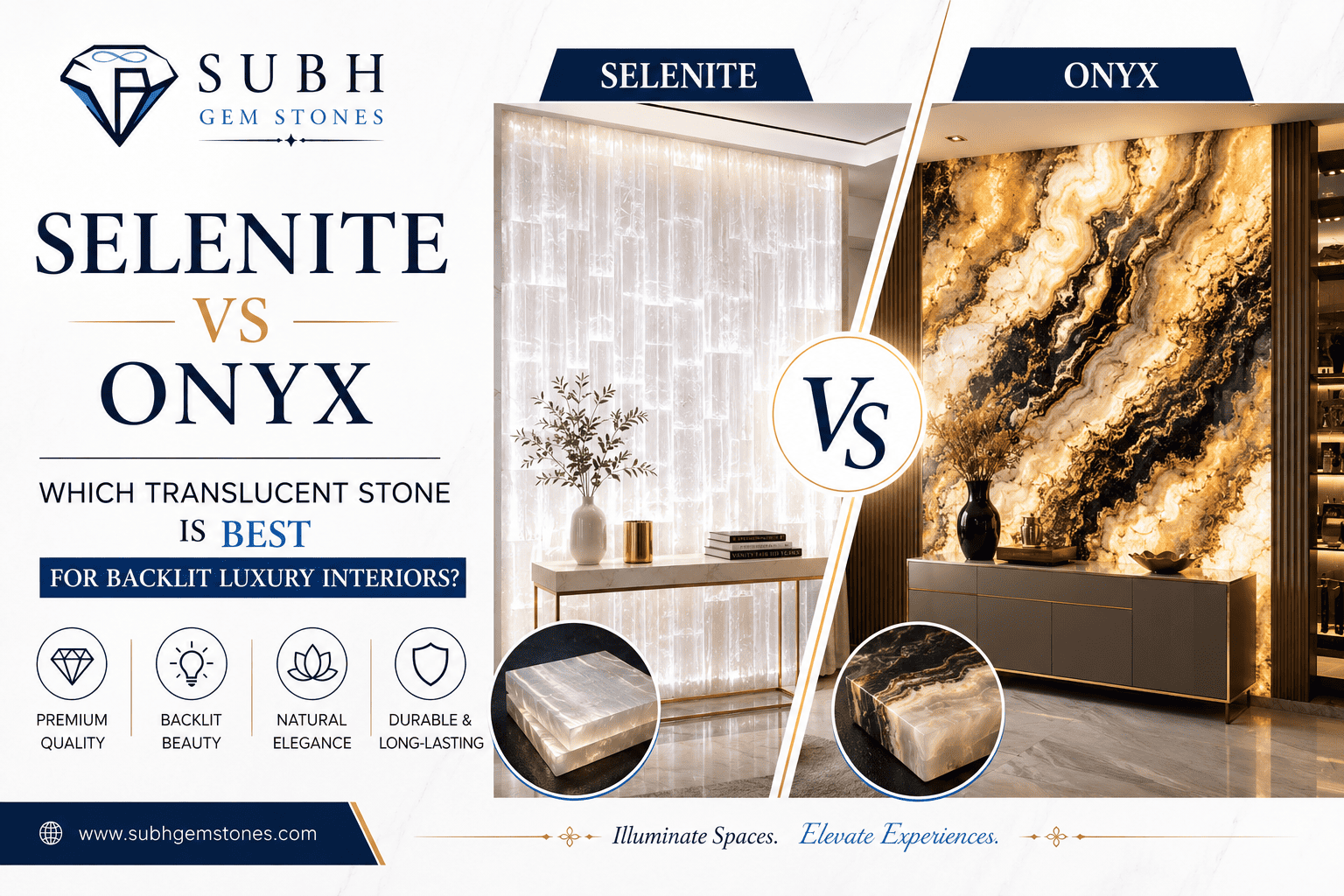
When designers and architects begin specifying natural stone for a backlit feature wall, the question almost always narrows to two materials: selenite slab or onyx slab. Both are translucent natural stones that produce extraordinary visual effects when LED illuminated from behind. Both are genuine luxury materials with a provenance that no engineered or manufactured surface can claim. But they are not interchangeable and choosing the wrong one for your specific project brief can result in an effect that fails to deliver what the design required.
This guide makes the comparison clear and direct, covering every decision criterion a designer, architect, or buyer needs to make the right choice between selenite and onyx for a backlit wall project.
Selenite Slab What Makes It Unique?
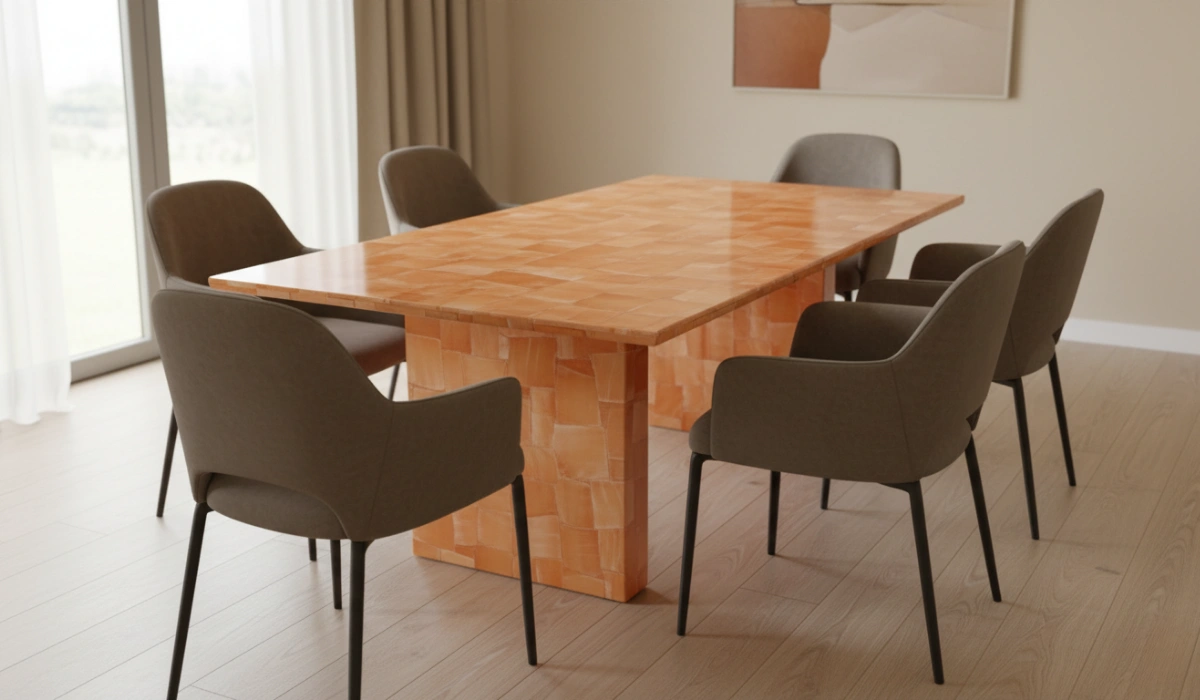
Selenite is a crystallised form of gypsum (CaSO₄·2H₂O) with a Mohs hardness of 2 and a fibrous crystalline structure that diffuses LED light in a uniquely even, soft, and continuous manner across the full surface of each panel. The effect is often described as the ‘moon glow’ or ‘lunar light’ effect a warm, pearlescent, calming illumination that feels atmospheric rather than dramatic.
Selenite’s key advantages for backlit wall applications:
• Extremely even light distribution no hot spots, no shadow bands, no vein concentration points
• Lightweight relative to most natural stones a critical advantage for ceiling panel applications
• Warm pearlescent white tone pairs beautifully with warm metals (gold, brass, bronze) and neutral palettes
• More accessible price point than onyx in most market contexts
• Available in smooth panel and Selenite Brick (textured dimensional) formats from Subh Gem Stones
Selenite’s limitations:
• Mohs hardness 2 cannot be used for countertops, flooring, or any surface application
• Water soluble avoid sustained moisture contact; not suitable for external applications
• No colour variety always white to cream; no green, black, honey, or red options
• Requires professional installation with mechanical fixings not suitable for DIY
Onyx Slab What Makes It Different
Onyx is a banded form of chalcedony (a microcrystalline quartz) with a Mohs hardness of 6.5–7 dramatically harder than selenite and suitable for countertop and light surface applications as well as backlit wall use. Onyx is typically characterised by bold, flowing vein formations in white, honey, green, black, red, or blue tones that become dramatically illuminated when light passes through the stone from behind.
Onyx’s key advantages:
• Bold, dramatic, high contrast backlit vein illumination the defining onyx effect
• Wide colour range white, honey, green, black, red allows strong design palette matching
• Mohs 6.5–7 suitable for backlit countertops, vanity tops, and bar surfaces as well as walls
• Strong brand recognition onyx is widely known by end clients as a premium luxury material
Onyx’s limitations:
• Higher price per square foot in most markets than selenite
• Heavier than selenite ceiling panel installations require stronger structural support
• Light distribution is less even veining can create brighter and darker zones when backlit
• Requires sealing and more rigorous maintenance than selenite for wall applications
Experience 80+ Designs at Our Kishangarh Showroom
Subh Gem Stones manufactures and exports premium semi-precious stone slabs from our 1,25,000 sq ft facility in Kishangarh, Rajasthan. Visit our Experience Center to see, touch, and compare every design before you decide. Custom sizes available for all residential, commercial, and hospitality projects.
GET IN TOUCH WITH USSelenite vs Onyx — Full Comparison Table
| Factor | Selenite Slab | Onyx Slab |
|---|---|---|
| Mohs Hardness | 2 walls and ceilings only | 6.5–7 walls, some countertop use |
| Backlit Effect | Soft, even, atmospheric moon-glow | Bold, dramatic, high-contrast veining |
| Colour Options | White, cream, pale gold only | White, honey, green, black, red, blue |
| Translucency | Very high even diffusion | High veining concentrates light |
| Weight | Lighter ideal for ceilings | Standard stone weight |
| Price | Generally lower per sq ft | Premium higher cost per sq ft |
| Installation | Specialist required mechanical fixings essential | Standard stone installation protocols |
| Maintenance | Dry cloth only; avoid moisture | Seal annually; standard stone cleaning |
| Countertop Use | Not suitable too soft | Yes with sealing |
| Best Use Case | Large format backlit walls, ceiling panels, partitions | Statement backlit panels, countertops |
| Ideal Design Style | Spa, wellness, calm luxury, minimalist | Bold luxury, maximalist, dramatic contrast |
The Verdict — Which Should You Choose?
Choose selenite slab if: your brief is a large format backlit feature wall or ceiling panel where soft, even, atmospheric light quality is the design goal; budget is a consideration; or the installation is a ceiling where weight must be minimised. Selenite is the clear leader for these applications.
Choose onyx slab if: the brief requires bold, dramatic, high contrast illuminated veining; the stone will serve a dual purpose as a backlit surface AND a countertop or vanity top requiring surface hardness; or a specific onyx colour (honey, green, black) is needed for the design palette.
For projects where both effects are desired for example, a selenite ceiling combined with an onyx backlit bar counter both materials can be specified from a single manufacturer. Subh Gem Stones supplies both selenite slabs and onyx from our Kishangarh, Rajasthan manufacturing facility, with custom sizing and global export to 25+ countries.
Buy Selenite Slabs or Compare Options — Contact Subh Gem Stones
Our team in Kishangarh can advise on the right translucent stone for your specific backlit wall project and provide samples of both selenite slabs and other exotic stone varieties before you place an order.
Call / WhatsApp: +91-9468720301 | +91-8955298811 | +91-8233202376
Explore: Selenite Slab Collection → | Submit Enquiry →
Frequently Asked Questions
1. Is selenite or onyx more translucent?
Selenite is generally considered more translucent than onyx, with a more even light diffusion across the full slab surface. Onyx allows light through its veining, creating a dramatic high contrast effect. For uniform, even backlighting, selenite is the superior choice. For bold, dramatic vein illumination, onyx is preferred.
2. Which is cheaper selenite or onyx slab?
In most markets, selenite slab is more price-accessible than onyx. However, price varies significantly by source, size, thickness, and quantity. As a direct manufacturer from Kishangarh, Rajasthan, Subh Gem Stones offers competitive pricing on both selenite slabs and other translucent stone materials. Contact our team at +91-9468720301 for current pricing.
3. Can selenite slab be used for countertops?
No. Selenite has a Mohs hardness of 2, making it far too soft for countertop or flooring applications. Selenite is exclusively a wall panel, ceiling panel, and partition material. If you need a backlit countertop surface, onyx (Mohs 6.5–7) is the appropriate specification.
4. Where can I buy selenite slabs in India?
Subh Gem Stones is a leading manufacturer and exporter of selenite slabs based in Kishangarh, Rajasthan India’s primary gemstone slab production hub. We supply selenite slabs in standard smooth panel and Selenite Brick formats to buyers across India and 25+ countries worldwide. Contact +91-9468720301 for pricing and samples.