

Selenite Slab Buying Guide: How to Choose the Best Quality for Luxury Interiors
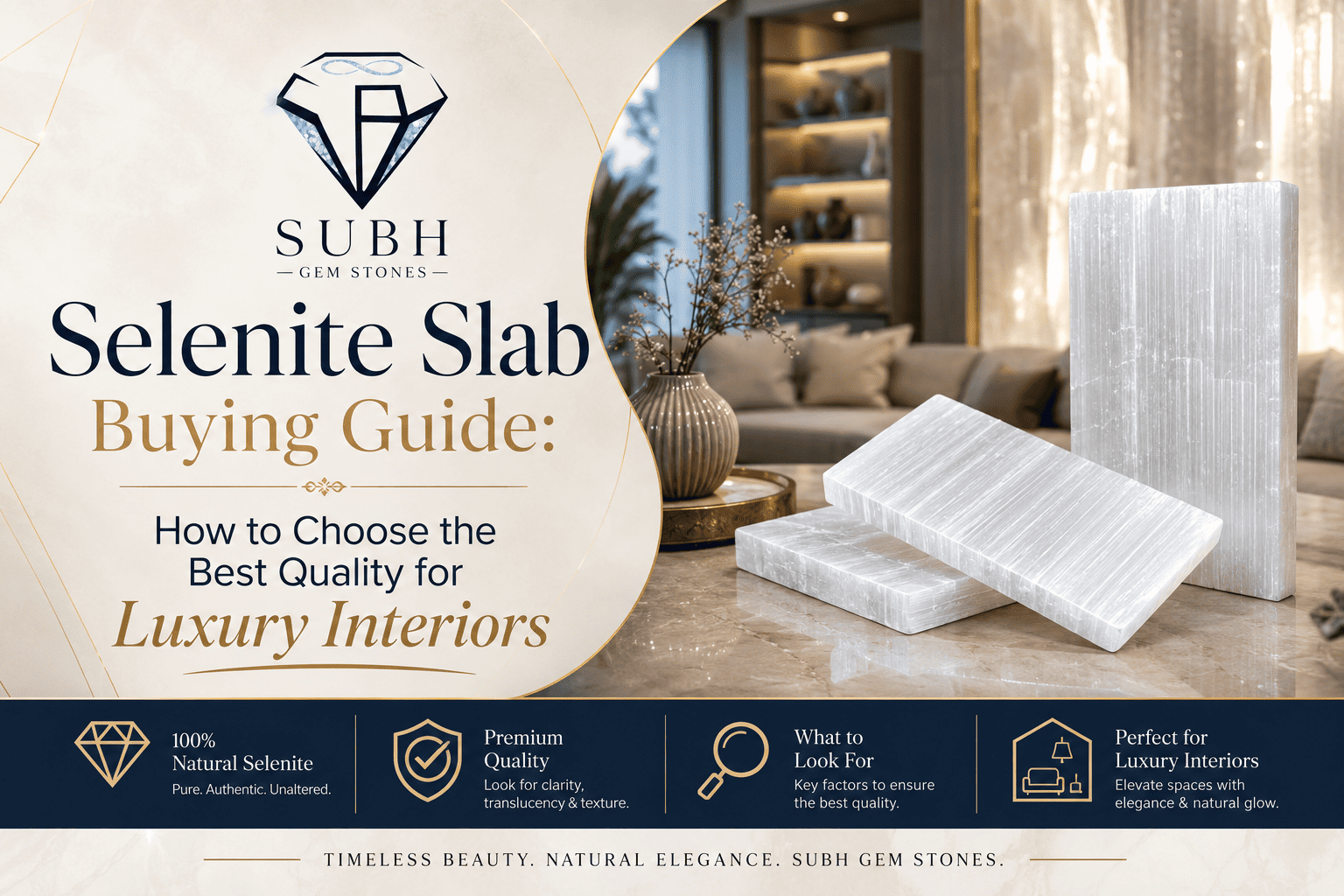
Selenite slabs have become one of the most sought after materials in luxury interior design. Whether you are planning a glowing backlit feature wall, a translucent ceiling panel for a boutique hotel, or an ethereal partition screen for a residential penthouse, selenite delivers a visual quality that no other natural stone can replicate. Yet with growing demand comes a flood of low quality and even fake material in the market. This guide answers every question a serious buyer needs answered before placing an order, from identifying genuine stone to understanding size, pricing, care, and where to buy with confidence.
Table of Contents
What Is a Selenite Slab?
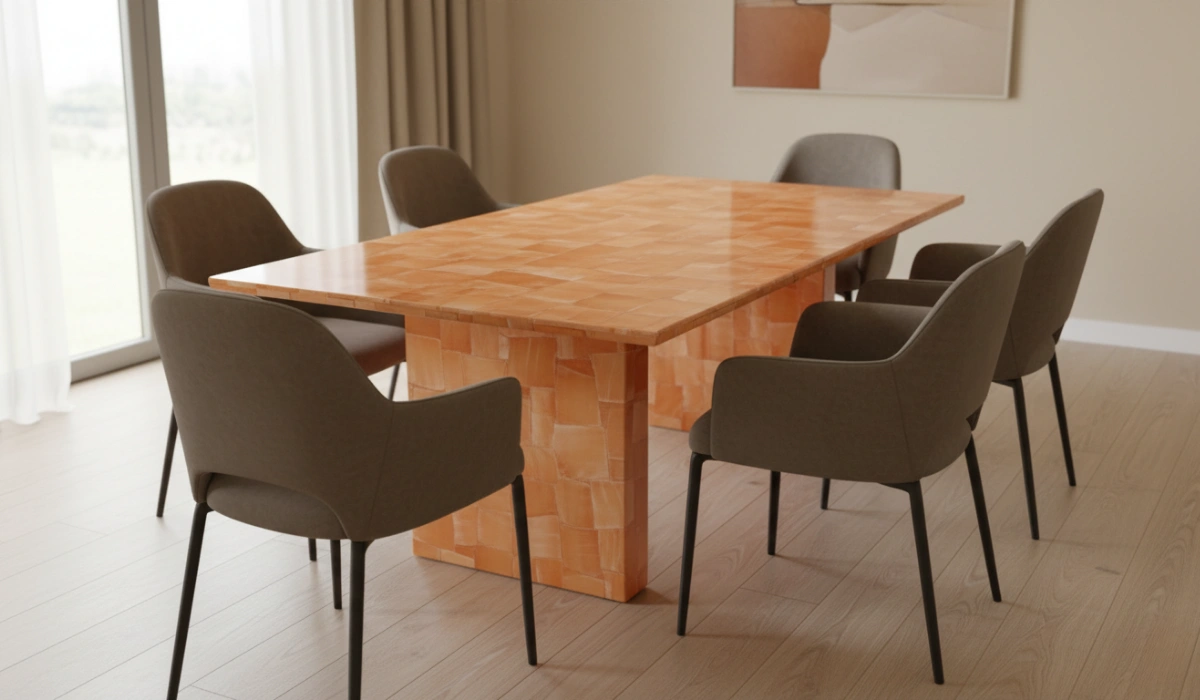
Selenite is a crystalline form of gypsum with the chemical composition CaSO4 2H2O. Unlike most gemstones that are valued for colour and hardness, selenite is prized for its extraordinary capacity to transmit light through its crystalline structure. When a selenite slab is placed against an LED light source, it produces a soft, warm, pearlescent glow that resembles moonlight. This is no coincidence: the stone takes its name from Selene, the Greek goddess of the moon.
Selenite belongs to the same mineral family as alabaster and satin spar, but its unique light transmission at architectural scale makes it a material category of its own. It forms in evaporite deposits where ancient seas or lakes evaporated over millions of years, leaving behind thick crystalline beds that are quarried, cut into panels, and finished for interior applications.
At Subh Gem Stones, we manufacture two primary selenite slab variants from our Kishangarh, Rajasthan facility: the Selenite Smooth Panel, which offers a clean polished surface for modern interiors, and the Selenite Brick Textured Pattern, which adds dimensional character to feature walls.
Experience 80+ Designs at Our Kishangarh Showroom
Subh Gem Stones manufactures and exports premium semi-precious stone slabs from our 1,25,000 sq ft facility in Kishangarh, Rajasthan. Visit our Experience Center to see, touch, and compare every design before you decide. Custom sizes available for all residential, commercial, and hospitality projects.
GET IN TOUCH WITH USSelenite Slab Applications in Luxury Interiors
Selenite slabs are specified across a wide range of luxury commercial and residential projects. The most impactful applications include:
• Backlit feature walls: A full height selenite slab wall mounted against recessed LED panels creates a uniform, warm, pearlescent glow that transforms any room from ordinary to extraordinary.
• Ceiling panels and canopy features: Selenite is lighter than marble and granite, making it practical for ceiling tile installations in luxury hotel suites, penthouses, and spa facilities.
• Partition walls and room dividers: Selenite panels allow diffused light to pass through while maintaining visual privacy, offering a luminous alternative to frosted glass in office lobbies and open plan living spaces.
• Reception desk backdrops and lift lobbies: Selenite accent panels behind reception desks or in elevator lobbies create a sophisticated focal point in commercial interiors.
• Meditation, yoga, and wellness spaces: The calm visual quality of selenite makes it the preferred material for high end spa treatment rooms, meditation studios, and wellness centres.
For a complete guide to designing backlit walls with selenite, read our detailed article: Selenite Slab for Backlit Walls — The Complete Design & Buying Guide 2026
Selenite Slab Technical Specifications
Before purchasing any selenite slab, review the key technical parameters to ensure suitability for your project:
| Specification | Detail |
|---|---|
| Material | Natural Selenite Crystalline Gypsum (CaSO₄·2H₂O) |
| Mohs Hardness | 2 (suitable for wall, ceiling, and partition applications) |
| Translucency | High semi translucent to near transparent |
| Available Variants | Selenite Smooth Panel, Selenite Brick Textured Pattern |
| Recommended Thickness | 10 mm to 15 mm for backlighting; 20 mm for structural panels |
| Surface Finish | Polished, Satin |
| Custom Sizes | Available from Kishangarh, Rajasthan manufacturing facility |
| Best Applications | Backlit feature walls, ceiling panels, partition screens, accent walls |
| Not Recommended For | Countertops, flooring, bathroom vanity tops, outdoor applications |
| LED Colour Temperature | Warm White 2700K to 3500K for the best glow effect |
Important note on hardness: A Mohs hardness of 2 means selenite scratches easily. It is not suitable for countertops, flooring, or bathroom vanity tops where abrasion or water contact is inevitable. Selenite performs beautifully on vertical wall surfaces, ceilings, and partitions where it is protected from physical wear.
What to Look for When Buying a Selenite Slab?
Knowing what to check before you buy protects you from wasting money on low quality or misrepresented material. Here is what every serious buyer should evaluate:
Translucency and Light Transmission
The defining quality of a premium selenite slab is uniform light transmission. Hold the slab up to a strong light source or test it against an LED panel. A quality slab will glow evenly from edge to edge with no dark patches, dense streaks, or opaque areas. Uneven translucency suggests dense gypsum inclusions or impurities within the crystal structure.
Surface Consistency
Examine the surface under good lighting. Genuine high quality selenite has a layered, fibrous crystal structure visible as fine parallel striations across the surface. These are natural and desirable. What you want to avoid is excessive pitting, rough edges, large voids, or visible cracks that were not disclosed by the supplier.
Colour and Clarity
Natural selenite ranges from pure translucent white to warm ivory. Faint beige, pale gold, or light grey tones are completely normal colour variations caused by trace mineral content during formation. Avoid slabs that appear artificially bleached, painted, or coated to mask poor quality stone underneath.
Thickness Consistency
For backlit applications, thickness uniformity across the slab is critical. Variations in thickness of more than 1 mm to 2 mm across a single panel will produce uneven light distribution when backlit. Ask your supplier for thickness tolerance specifications and request a quality certificate.
Finish Quality
A polished finish should be smooth and reflective without swirl marks. A satin finish should have a consistent low sheen. Rough or patchy finishing indicates poor quality processing at the fabrication stage.
Supplier Verification
Buy directly from a manufacturer or a verified specialist exporter rather than an intermediary who has no visibility into the source material. Direct manufacturers like Subh Gem Stones in Kishangarh can provide origin documentation, quality certificates, and custom cutting to your exact project dimensions.
Selenite Slab Sizes Explained: Small vs Large
Choosing the right size depends entirely on your application. Here is a practical breakdown:
| Size Range | Price Tier | Typical Source |
|---|---|---|
| Small Decorative Slab (under 30 cm) | Entry Level | Wellness stores, online marketplaces |
| Mid Size Panel (30 cm to 90 cm) | Mid Range | Interior décor suppliers, stone traders |
| Large Architectural Slab (90 cm to 180 cm) | Premium | Direct manufacturers, specialist exporters |
| Custom Oversized Panel (above 180 cm) | Luxury | Factory direct from Kishangarh |
For architectural backlit walls, standard panel sizes from our factory range from 60 cm x 30 cm up to 180 cm x 90 cm. Larger custom sizes are available for bespoke projects and should be discussed directly with our team to confirm structural requirements and logistics.
Beginner recommendation: If you are purchasing selenite for the first time for a residential project, a mid size panel of 60 cm x 40 cm is a practical starting point. It is large enough to demonstrate the full glow effect under backlighting but manageable enough to handle, install, and test without the complexity of an oversized architectural panel.
Selenite Slab Pricing Guide: Budget vs Premium
Selenite slab pricing is influenced by several factors: slab size, thickness, surface finish, translucency grade, and whether you are buying retail or direct from a manufacturer. Understanding these factors helps you evaluate whether you are paying a fair price or overpaying.
What drives the price of a selenite slab upward?
• Large format slabs with high translucency and uniform crystal structure are rarer and command premium prices.
• Thinner slabs (10 mm to 12 mm) require more careful cutting and finishing and are priced higher than thicker, heavier panels.
• Polished finishes involve additional processing steps compared to natural or satin finishes.
• Custom sizes cut to project specifications cost more than standard format panels.
• Certified export quality material with documentation for luxury hotel or commercial projects commands a premium over retail decorative grade.
Budget vs Premium: What you should expect
• Budget tier: Smaller decorative slabs, thicker profiles, lower translucency, sold at retail through wellness stores or online marketplaces.
• Mid range: Medium format panels with reasonable translucency, suitable for accent features in residential projects.
• Premium tier: Large format, high translucency, thin profile architectural panels supplied by specialist manufacturers for hospitality and commercial projects.
For a comprehensive comparison of translucent stone pricing, read our article: Selenite vs Onyx: Which Translucent Stone Is Best for Backlit Luxury Interiors?.
If a price seems too low for the size and quality claimed, it is almost always a warning sign. Either the translucency is poor, the slab has been misrepresented, or the material is not genuine selenite but a synthetic resin lookalike.
How to Tell If Your Selenite Slab Is Real or Fake
As demand for selenite in luxury interiors has grown, so has the supply of synthetic resin panels designed to mimic its appearance. Here is how to verify authenticity:
• The scratch test: Selenite has a Mohs hardness of 2. A real selenite slab can be scratched easily with a fingernail or a copper coin. If the panel is resistant to scratching, it is not selenite.
• The light test: Backlit genuine selenite produces a warm, slightly uneven glow with the fibrous crystal pattern visible through the panel. Resin panels glow too uniformly and too brightly, resembling a lightbox more than a natural stone.
• The weight test: Selenite is noticeably lighter than marble or granite of the same thickness. If the panel feels unusually light even for its size, or conversely much heavier than expected, investigate further.
• The temperature test: Natural stone feels cool to the touch even at room temperature. Resin panels warm up to room temperature quickly and feel more like plastic.
• The edge inspection: Genuine selenite shows a layered crystalline structure on the edge cut. Resin shows a solid, featureless cross section.
• Buy from source: The most reliable protection against fake material is purchasing directly from a manufacturing facility that you can verify. Subh Gem Stones operates from Kishangarh, Rajasthan and welcomes factory visits and video verification calls for trade buyers.
Selenite Slab Care and Maintenance
Selenite requires careful handling and maintenance due to its softness and sensitivity to moisture. Follow these guidelines to preserve your slab in excellent condition:
Cleaning
• Dust the surface regularly with a soft, dry microfibre cloth. This is the safest and most effective routine cleaning method.
• For light surface marks, use a barely damp cloth and immediately dry the surface completely. Never allow water to pool on or soak into the slab.
• Do not use acidic cleaners, abrasive pads, or chemical solvents. These will etch or dissolve the selenite surface irreversibly.
Can Selenite Slabs Get Wet?
Selenite is water soluble over time. Brief contact with small amounts of moisture followed by thorough drying will not cause immediate damage, but repeated or prolonged exposure to water will dissolve the surface and cause deterioration. Selenite is therefore not recommended for bathrooms, outdoor applications, or any environment where condensation or humidity is high.
Protecting from Sunlight
Direct, prolonged sunlight exposure can cause surface micro fracturing over time due to thermal cycling. For backlit wall applications using LED panels, this is not a concern. For slabs displayed in sunlit spaces, use UV filtering glazing or position the slab away from direct sun exposure.
Storage
Store selenite slabs vertically with full face support on both sides to prevent bending stress. Always use padded protective wrapping and avoid stacking slabs horizontally without cushioning between each panel.
Travelling with a Selenite Slab
For smaller decorative slabs, wrap each piece individually in bubble wrap or foam padding, then pack tightly in a rigid case. For larger architectural panels, professional crating with foam lined wooden crates is essential. Subh Gem Stones handles full export packing and international freight logistics for all project orders.
Can You Repair a Chipped or Cracked Selenite Slab?
Minor chips on edges can be smoothed carefully with fine grit sandpaper. For cracks, a clear two part epoxy resin matched to the slab colour can be used to fill the fracture. Larger structural cracks, however, typically require replacing the panel rather than attempting a full repair that will always be visible under backlighting. A broken selenite slab that has cracked into two intact pieces can often still be used in smaller decorative applications or as a set charging plate, so damaged pieces need not always be discarded.
Selenite Slab vs Other Stones: Which Should You Buy?
Selenite is not competing with marble or granite in any application where durability and hardness are required. The comparison that matters most is with other translucent stones used in backlit luxury interiors:
Selenite vs Onyx
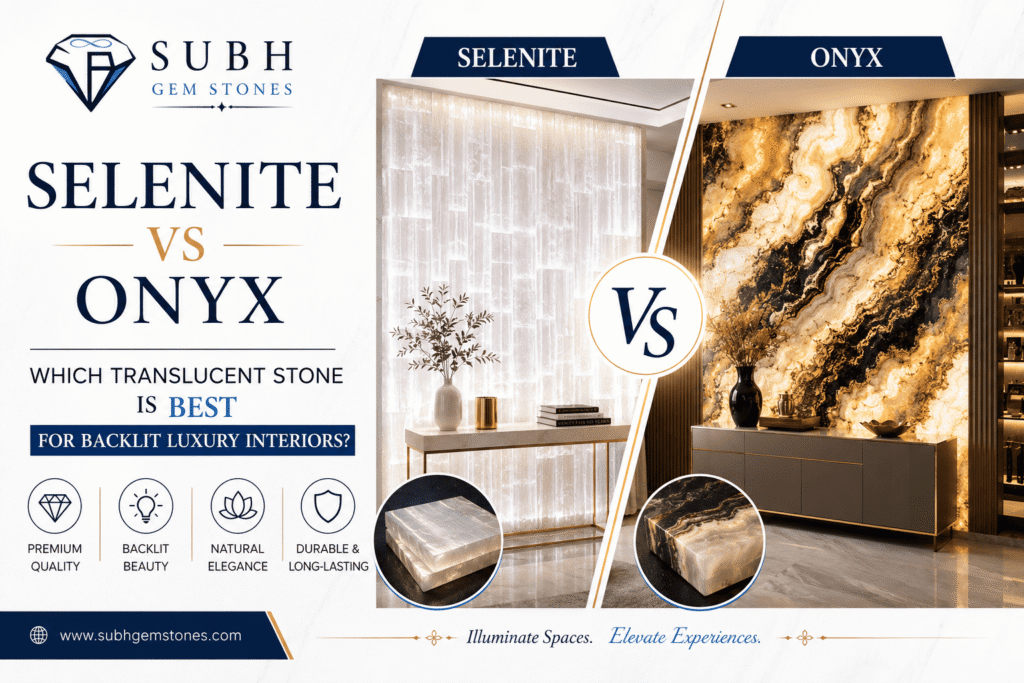
Onyx is harder (Mohs 6 to 7), heavier, more durable, and available in dramatic colour variations from green to red to honey amber. Selenite offers a purer, more ethereal white glow and is significantly lighter and easier to install at ceiling level. Selenite is typically more accessible in price for large format applications, while exotic onyx commands very high prices per square metre.
Selenite vs Alabaster
Alabaster is a closely related gypsum material, but its tighter microcrystalline structure gives it a more opaque, warmer glow compared to selenite. Selenite transmits more light and shows the fibrous crystal pattern through the panel, giving it a more distinctive and dynamic backlit appearance. For maximum visual drama in a backlit feature wall, selenite is generally the stronger choice.
Selenite Slab vs Selenite Tower
Selenite towers and wands are small decorative and wellness objects. Selenite slabs are architectural panels used to clad walls, ceilings, and partitions. They serve entirely different purposes. If your project involves cladding a surface, only slabs are appropriate. Towers and generators are spiritual and decorative objects that are not suitable for installation as panels.
Selenite Slab vs Selenite Chunk or Plate
Selenite plates are small flat pieces, typically 10 cm to 30 cm, sold primarily as crystal charging surfaces in wellness markets. Architectural selenite slabs are large format panels manufactured and finished for interior installation. While a plate can serve as a small decorative accent or surface, it is not the right product for a feature wall or ceiling installation.
Explore our full range of exotic and semi precious stone slabs at Subh Gem Stones Exotic Collection to compare selenite with our Silver Pyrite, Amethyst, and other premium stone options.
Why Buy Selenite Slabs from Subh Gem Stones?
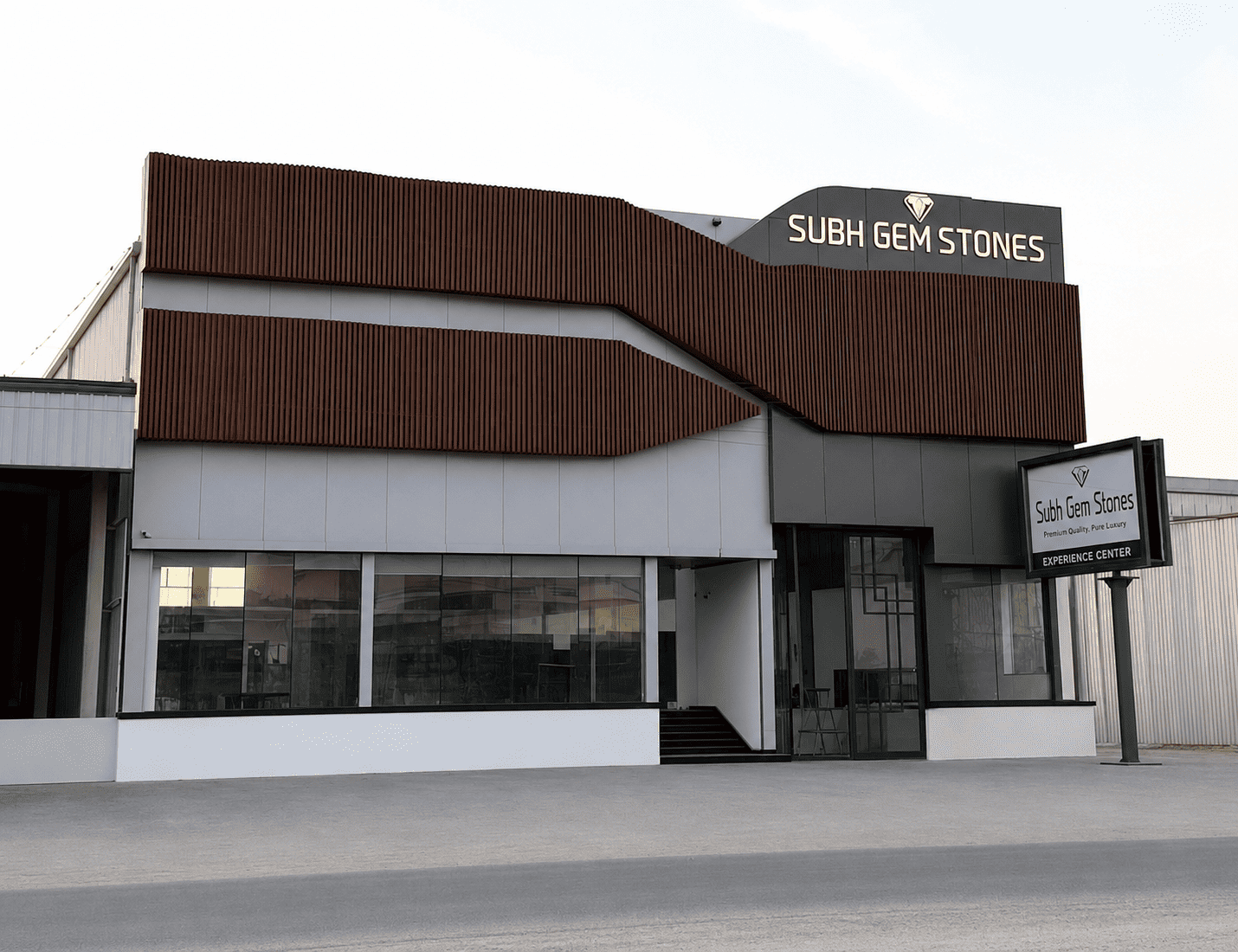
Subh Gem Stones is a direct manufacturer of selenite and semi precious stone slabs based in Kishangarh, Rajasthan, the heart of India’s gemstone slab manufacturing industry. Here is what distinguishes us from retail suppliers and intermediaries:
• Direct manufacturing: We cut, finish, and quality check every slab at our own facility. There is no middleman between the quarry and your project.
• Custom sizing: We cut panels to your exact project dimensions, whether you need 20 standard format panels or one large bespoke piece for a unique architectural feature.
• Export expertise: We supply luxury residential, hospitality, and commercial projects across 25 countries, with full export documentation, crating, and freight support on every order.
• Transparency: Trade buyers can request video verification of production, sample panels before full orders, and direct consultation with our specification team.
• Range: Our exotic collection includes selenite smooth panels, selenite brick texture, silver pyrite slabs, and a broad range of semi precious stone options for architects and interior designers looking for a single specialist supplier.
Contact our team directly to discuss your project:
• Phone: +91 9468720301 / +91 9552988111 / +91 8233202376
• Email: info@subhgemstones.in
Frequently Asked Questions
1. How much does a selenite slab cost?
The price of a selenite slab varies based on size, thickness, translucency grade, and whether you are purchasing retail or factory direct. Small decorative pieces start at modest price points, while large architectural panels for backlit walls are priced at a premium. Buying directly from a manufacturer in Kishangarh eliminates intermediary margins and gives you access to trade pricing with full quality assurance.
2. Where can I buy a genuine selenite slab?
The most reliable source for architectural grade selenite slabs is a direct manufacturer. Subh Gem Stones manufactures and exports selenite panels from Kishangarh, Rajasthan to buyers across 25 countries. You can also find smaller decorative pieces through specialist crystal and wellness retailers, but these are not suitable for architectural installation.
3. What size selenite slab should I buy for a feature wall?
For a feature wall, standard panel sizes of 60 cm x 30 cm to 120 cm x 60 cm are the most common starting point. Larger panels reduce the number of joints visible in the installation, which improves the visual continuity of the backlit effect. Custom large format panels up to 180 cm x 90 cm or beyond are available to order from our Kishangarh facility for bespoke architectural projects.
4. Can selenite slabs get wet?
Selenite is water soluble over time. Brief contact with moisture followed by immediate drying will not cause damage, but sustained or repeated exposure to water will dissolve and pit the surface. Selenite is not suitable for bathrooms, outdoor areas, or high humidity environments. For interior applications on dry walls and ceilings it is completely safe.
5. How long does a selenite slab last?
A selenite slab installed correctly on a protected interior wall or ceiling can last for decades with proper care. The primary risks to longevity are water exposure, physical abrasion, and impact damage. In a well designed backlit wall installation behind protective glass or in a dry interior environment, selenite panels have been observed in service for 15 to 20 years or more without significant deterioration.
6. How do I know if a selenite slab is real or fake?
Test it with your fingernail: genuine selenite scratches easily. Hold it to a strong light and look for the natural fibrous crystal pattern glowing through the stone. Resin fakes glow too uniformly and show no crystal structure. Genuine selenite also feels cool and is noticeably lighter than glass or resin of the same size. Buying from a verified manufacturer with production documentation is the safest approach.
7. Can you cut or shape a selenite slab?
Yes, selenite can be cut to custom dimensions. Its relative softness makes it easier to work with than harder stones like granite or onyx. However, cutting selenite requires the right equipment and skill to avoid fracturing the panel. Custom cutting should always be done at the manufacturing stage rather than on site. Subh Gem Stones provides custom cut panels to exact dimensions for every project order.
8. Are selenite slabs safe around children and pets?
Natural selenite is a non toxic mineral and poses no chemical hazard to people, children, or pets. The primary safety consideration is physical: selenite slabs are stone panels with sharp edges when cut, and they will crack or shatter if dropped or knocked hard. Panels should be installed securely and children should not be allowed to lean or press on exposed selenite surfaces. Small loose pieces should be kept out of reach of young children and animals.
9. Do I need multiple selenite slabs for a feature wall?
For any wall or ceiling feature of meaningful size, yes. A single panel is rarely large enough to cover an entire wall, so feature walls are always made up of multiple panels joined with thin grout lines or a frameless installation technique. The number of panels required depends on the wall dimensions and the panel size you select. Our team can help calculate panel quantities for your specific project once we have the wall dimensions.
10. Why are some selenite slabs more expensive than others?
Price differences reflect material grade, processing quality, and source. Slabs with higher translucency, greater size, thinner profile, and polished finish require more precise quarrying, cutting, and finishing work. Panels supplied with quality documentation for commercial projects carry additional value. The cheapest selenite available is almost always lower grade material with visible impurities, poor translucency, or inconsistent thickness that will produce a disappointing backlit effect. Investing in quality material from a verified manufacturer protects your project outcome and your budget over the long term.