

Selenite Slab
Selenite slab is a natural translucent stone formed from crystallised gypsum, chemically known as CaSO4.2H2O. It belongs to the same mineral family as alabaster and satin spar, but is distinguished by its unique ability to transmit light through its crystalline structure, producing a soft, warm, moon like glow when illuminated from behind. As a leading selenite supplier and manufacturer based in Kishangarh, Rajasthan, Subh Gem Stones cuts and polishes every selenite gemstone panel in house before exporting to design and hospitality projects across 25 or more countries.
We offer a complete range of selenite formats to suit different design needs, including the selenite crystal slab in its natural polished finish, textured selenite brick panels, and large format and round cuts for feature installations. Each variant is described below.
Selenite Brick Slab
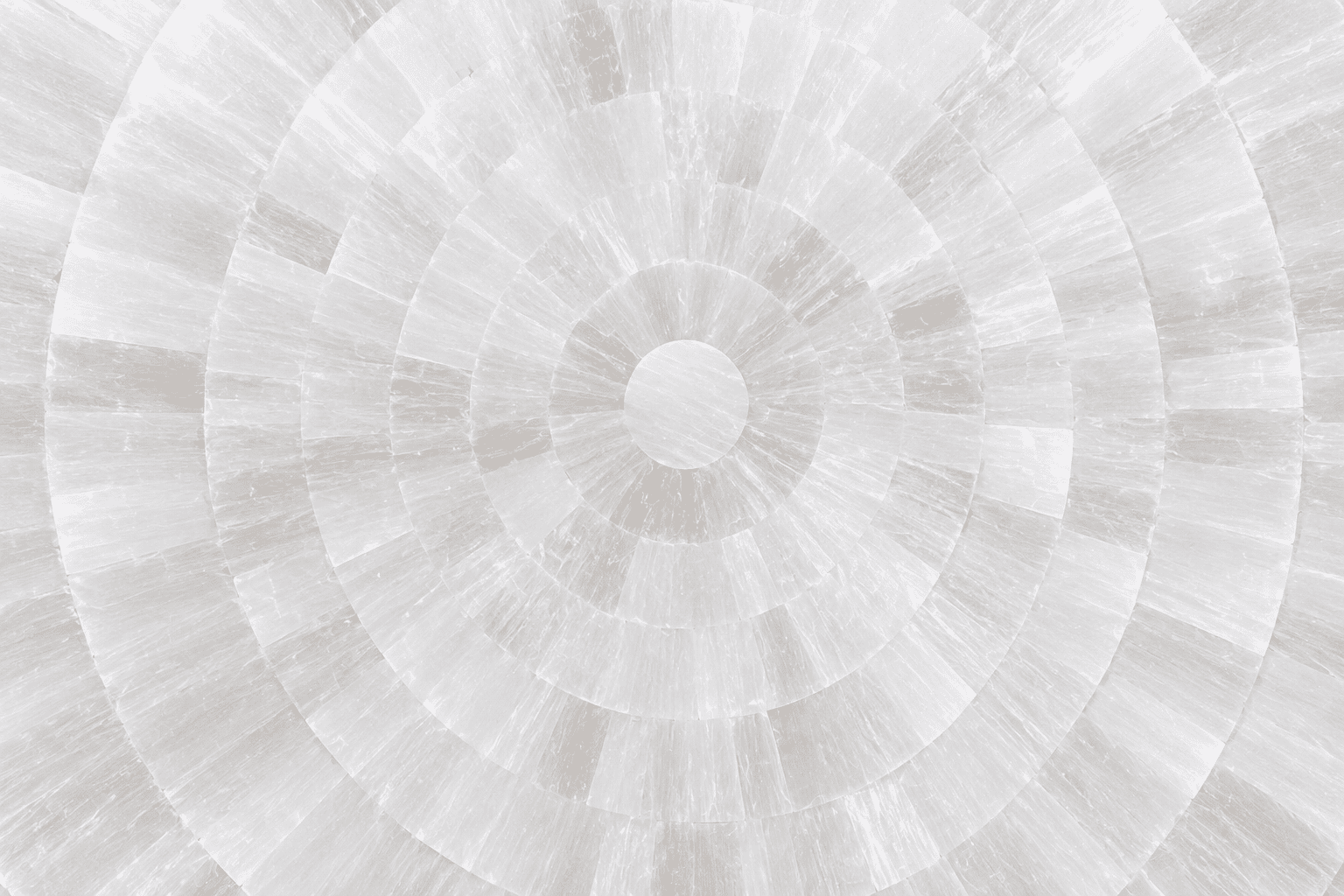
The selenite brick slab is a textured, dimensional panel cut into a brick like pattern, giving it a distinctive three dimensional appearance once backlit. It is a popular choice for statement accent walls where a raw, sculptural texture is preferred over a smooth polished finish. Buyers researching selenite brick slab price can contact our team for current rates based on panel size and thickness.
Large Selenite Slab
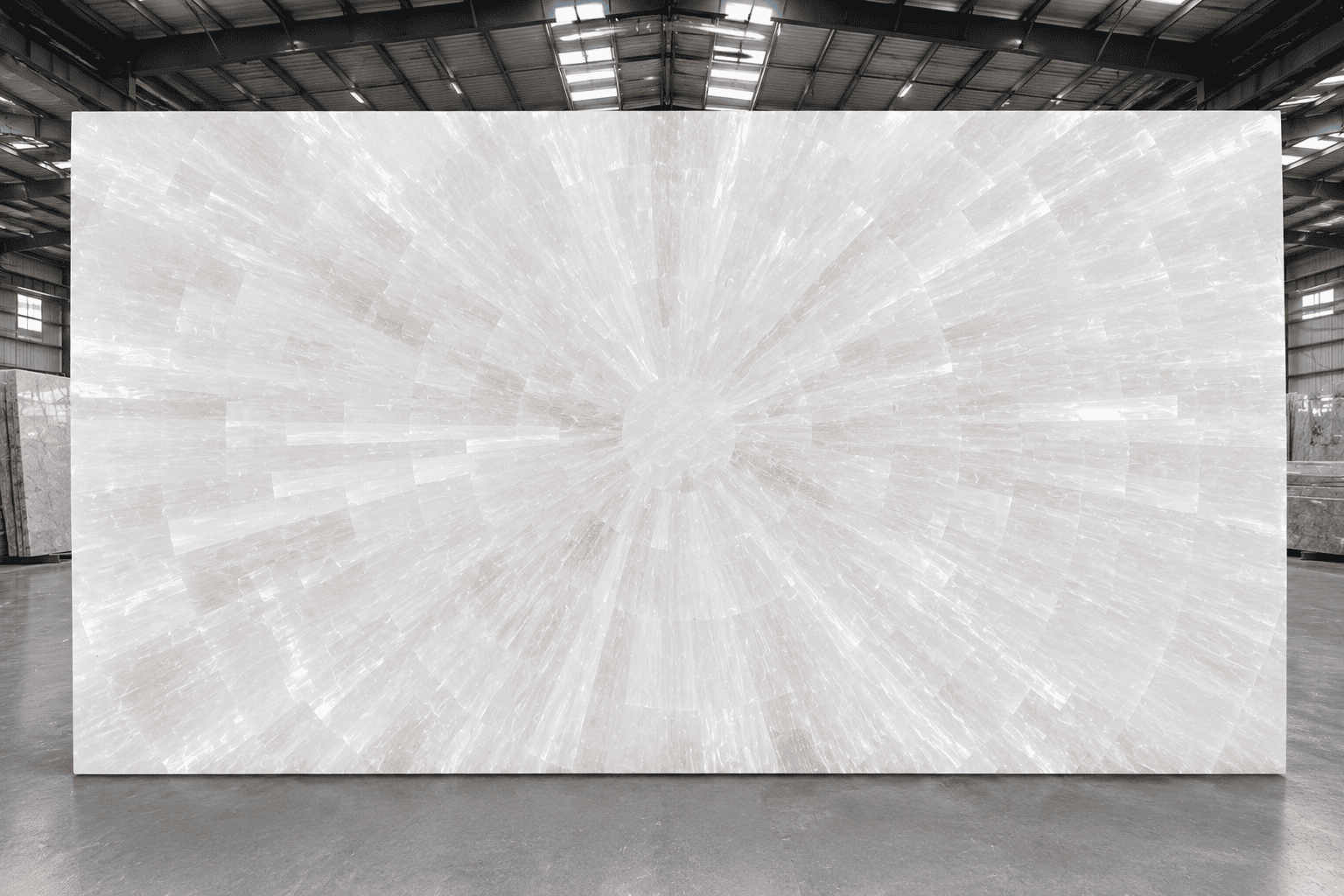
A large selenite slab is manufactured for full height feature walls and ceiling installations where a single continuous glowing surface is required. Producing consistent translucency across a larger format panel takes careful selection of raw material, which is part of why this size is specified for premium hospitality and residential projects.
Round Selenite Slab
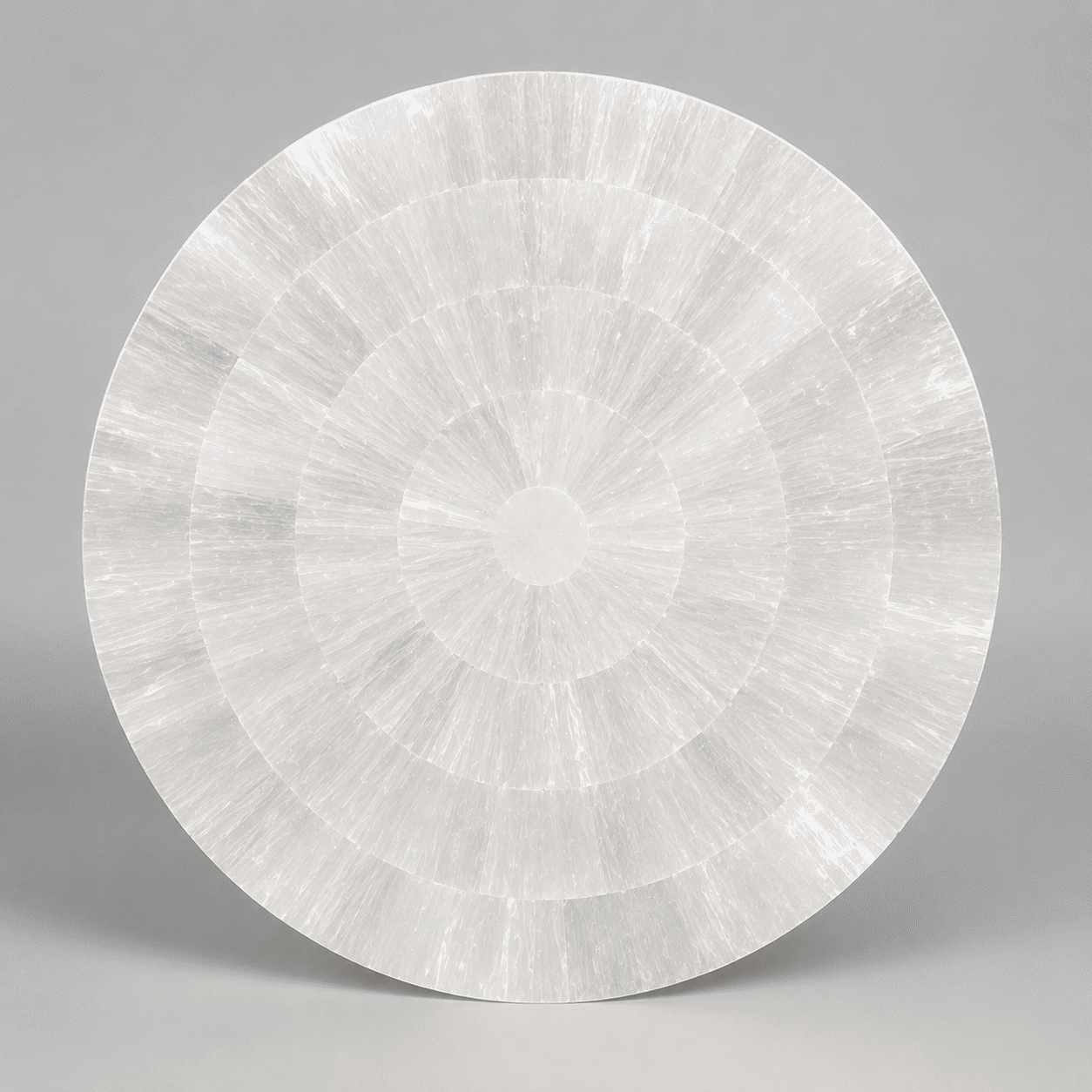
A round selenite cut is most often used for center tables and round table tops, since the circular shape displays the natural veining of the stone evenly from every viewing angle. It is also used for smaller decorative discs and coasters.
Raw Selenite Slab
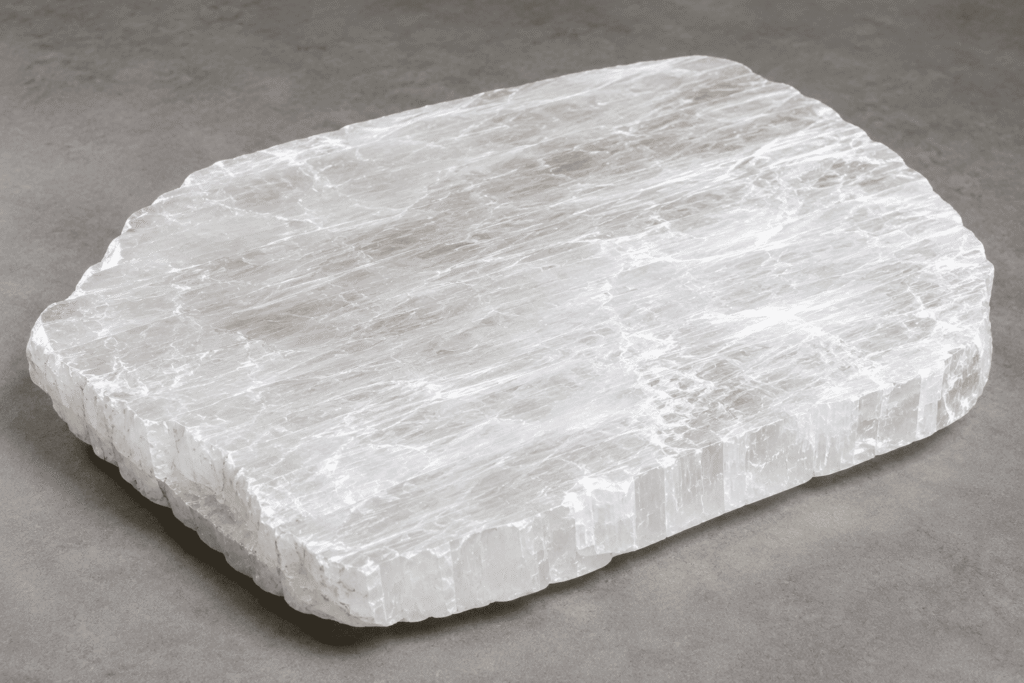
A raw selenite slab retains its natural, unpolished surface texture rather than a mirror finish, appealing to interiors that favour an organic, earthy aesthetic while still allowing light to pass through when backlit.
Selenite Crystal Slab
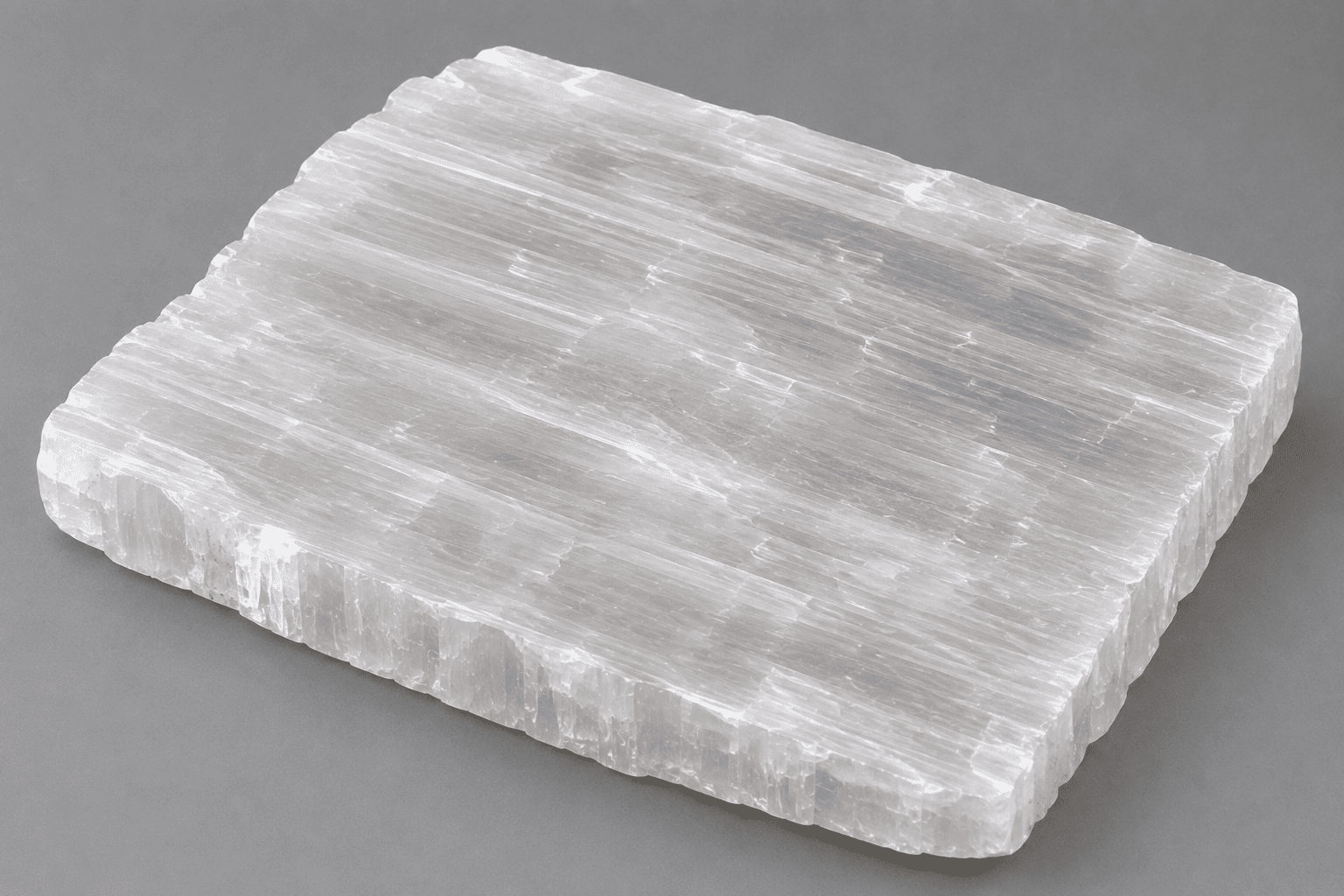
The selenite crystal slab refers to our standard polished panel format, prized for its clarity and even light diffusion. This is the most commonly specified variant for backlit feature walls and partition screens.
Selenite Door Slab
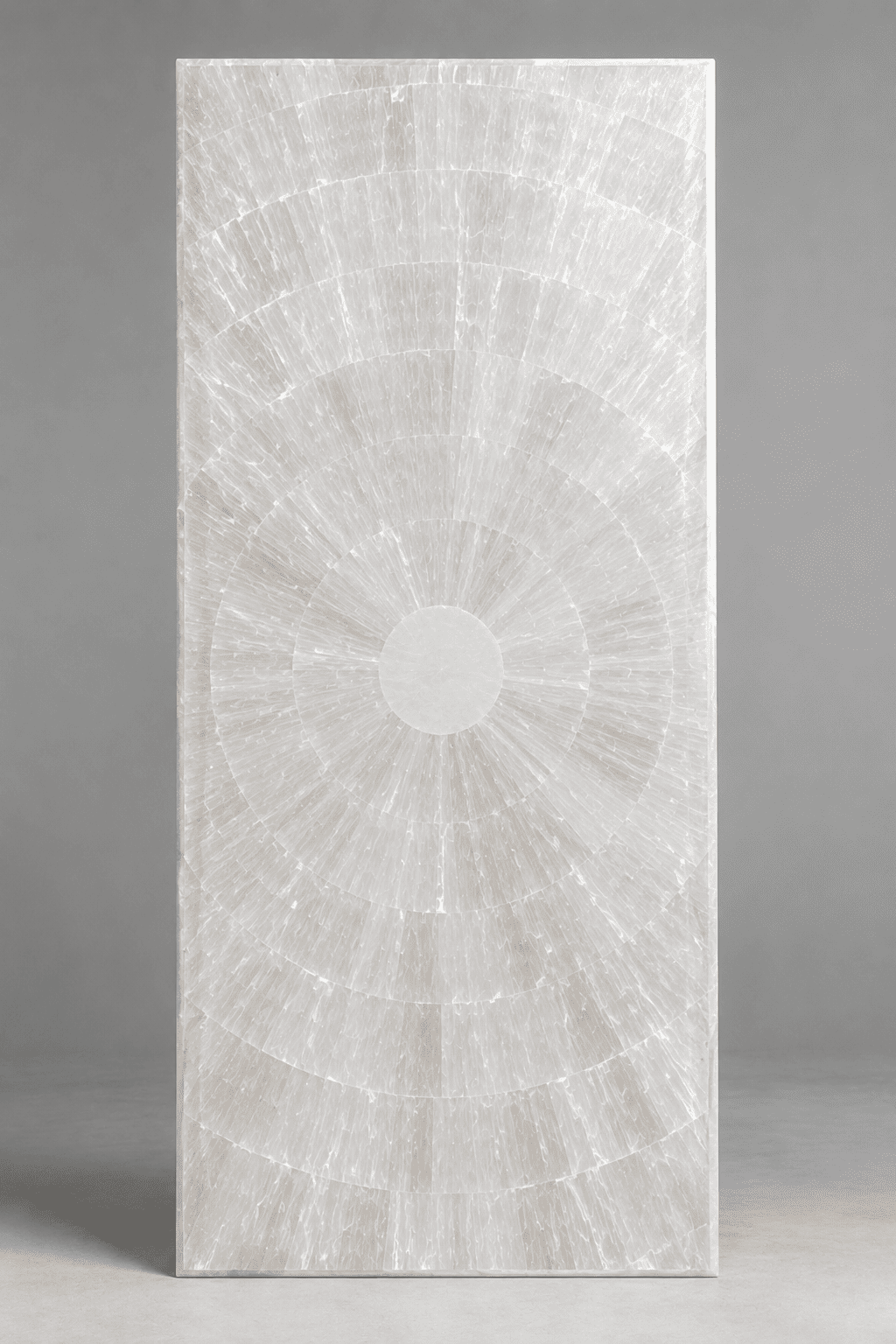
A selenite door panel is a niche but growing application, where thin selenite sheets are set into a door frame and backlit to create a glowing entryway feature. This is typically produced as a custom order for luxury residential and hospitality projects.
Sizes and Specifications of Selenite Slabs
| Specification | Details |
| Material | Natural Selenite Crystalline Gypsum (CaSO₄·2H₂O) |
| Mohs Hardness | 2, best suited for wall, ceiling and decorative panel applications rather than high-traffic work surfaces |
| Translucency | High, semi-translucent to near transparent depending on slab thickness and density |
| Available Variants | Selenite Smooth Panel, Selenite Brick, Selenite Crystal Slab, Raw Selenite Slab, Round Selenite, Selenite Door |
| Standard Sizes | Large format slabs available on request from our Kishangarh manufacturing facility, along with round and custom cut panels |
| Recommended Thickness for Backlighting | 10 mm to 15 mm for maximum light transmission, 20 mm for structural panels |
| Surface Finish | Polished, Satin, Raw Textured |
| LED Colour Temperature | Warm White (2700K to 3500K) recommended for the best selenite glow effect |
| Selenite Slab Price | Pricing depends on slab size, thickness and finish. Contact our team for the latest selenite slab and selenite brick slab prices. |
| Not Recommended For | Flooring, outdoor installations, and high-moisture or heavy-use surfaces without protective sealing |
Get Best Price for Selenite Slabs and Send Your Enquiry
If you are looking to buy selenite slabs for a residential, hospitality or commercial project, our team can guide you through size, thickness and finish options based on your installation. Selenite slabs for sale at Subh Gem Stones are manufactured directly at our Kishangarh facility, which means competitive factory pricing and no middleman markup.
Contact us for a formal quote:
- Phone: +91-9468720301, +91-8955298811, +91-8233202376
- WhatsApp: +91 89552 98811
- Email: info@subhgemstones.in
- Address: G 67, RIICO Industrial Area, Silora, Kishangarh, Rajasthan 305801, India
Selenite Slab Applications
Selenite is a versatile decorative stone once its softness is respected in the design. Below is how selenite slab performs across our standard thirteen application categories.
Selenite Slab
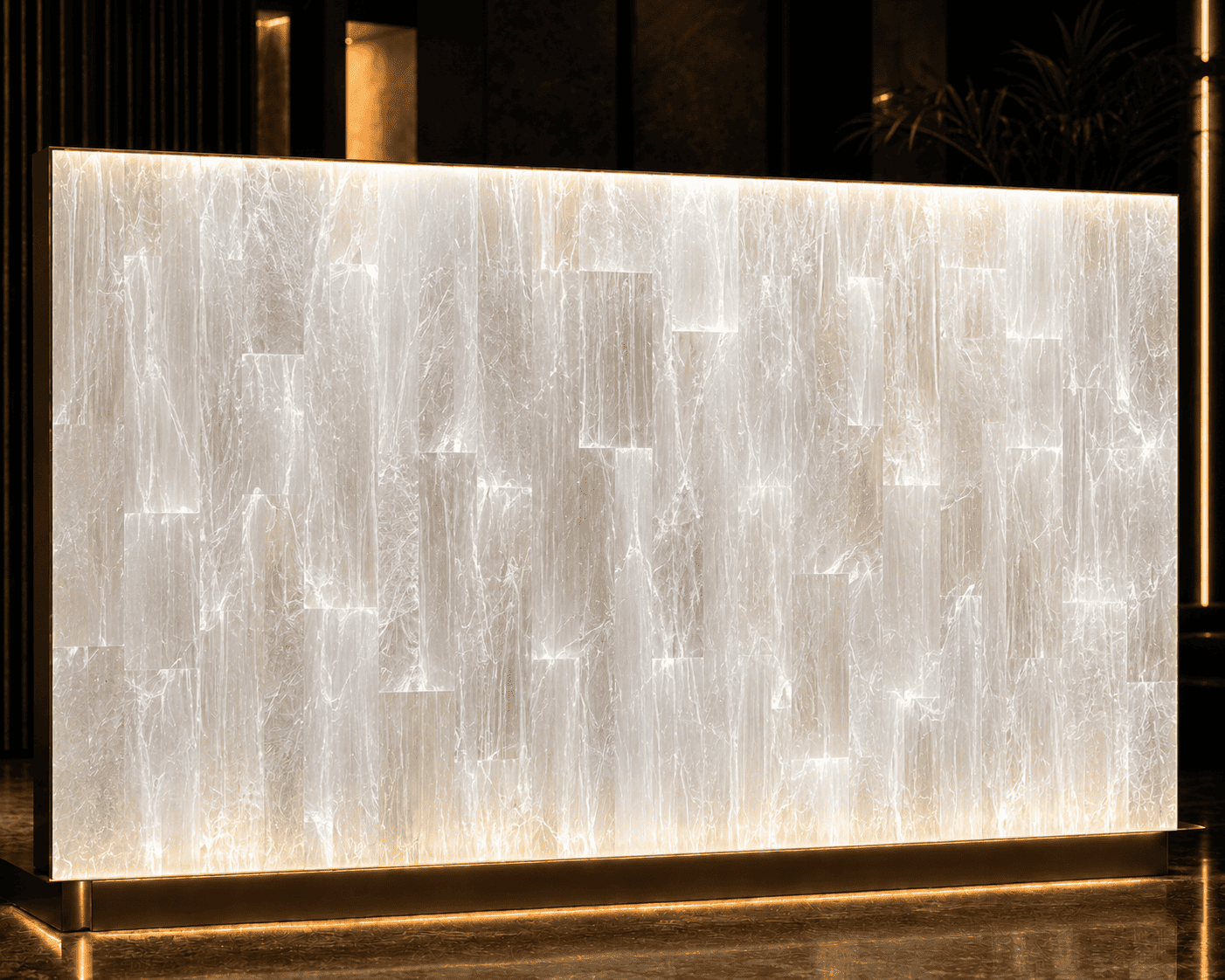
The selenite slab is the foundation of this collection and works as a large format panel for feature installations. Its natural translucency makes it one of the most requested materials for designers who want a glowing centrepiece in a residential or hospitality project.
Selenite Countertop
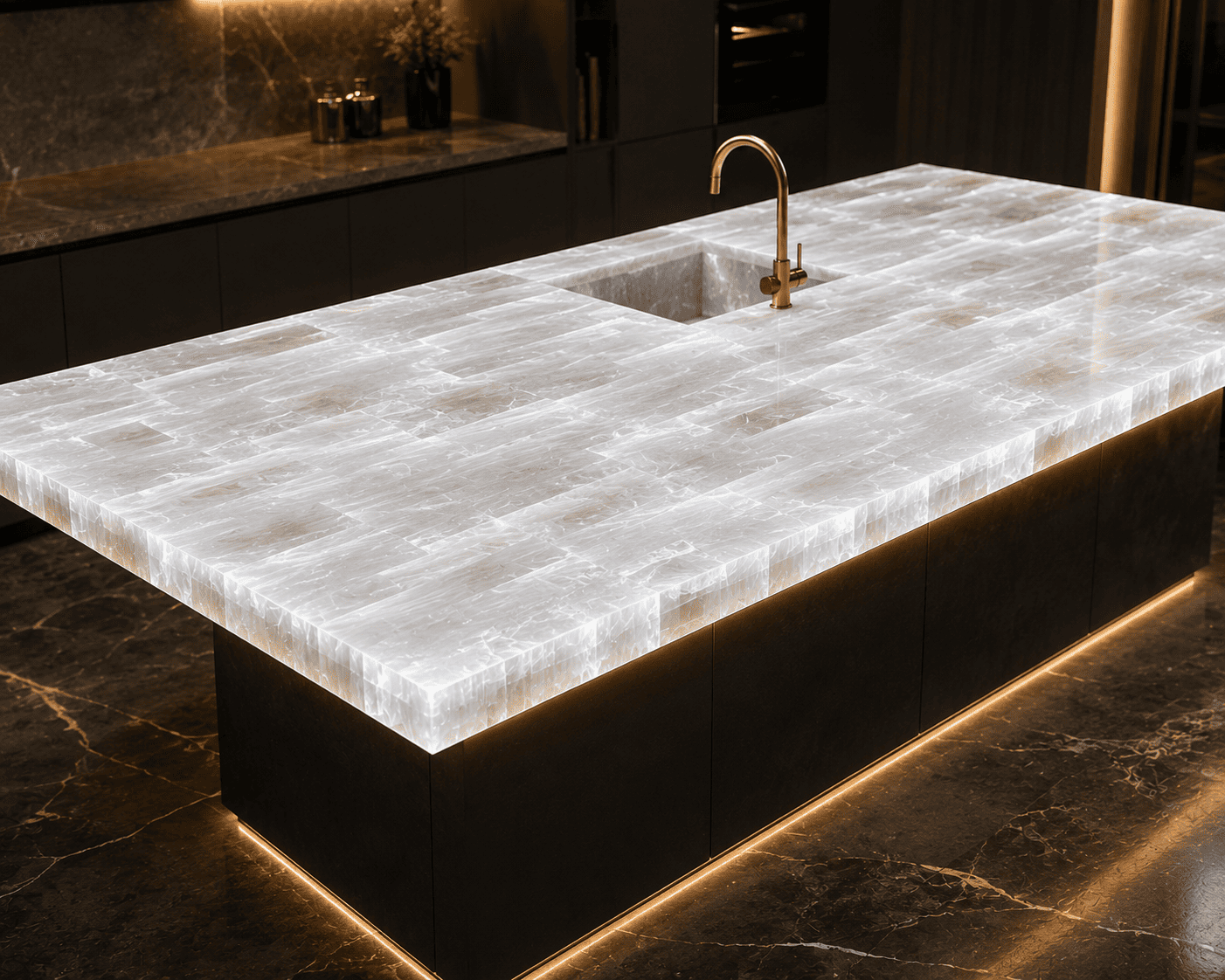
Due to a Mohs hardness of 2, a full selenite slab is not recommended as a primary kitchen countertop, since daily scratching and moisture exposure can wear the surface over time. It performs well instead as a decorative countertop inlay or a backlit display counter in showrooms, bars and reception counters where heavy daily use is not a concern.
Selenite Table Top
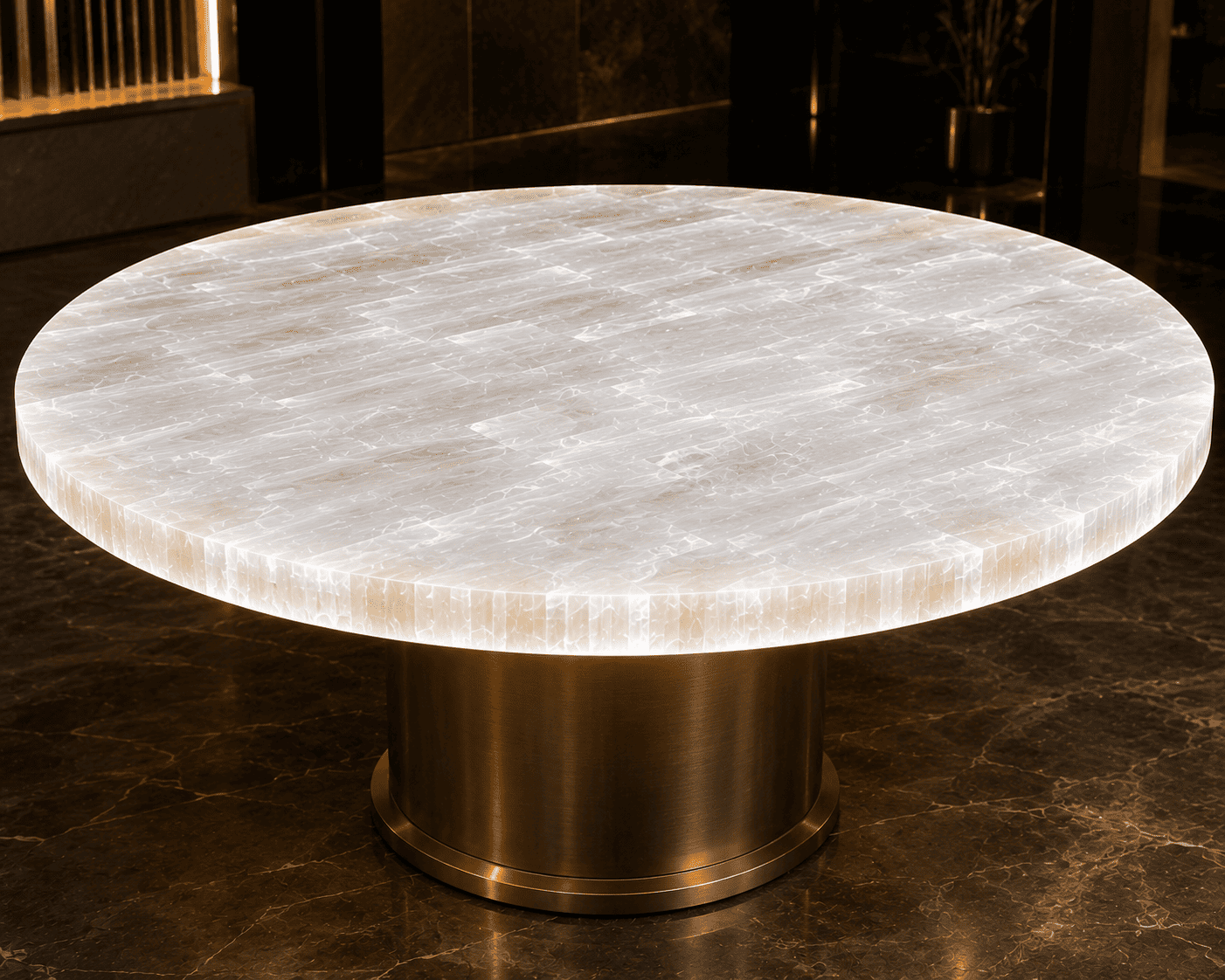
A selenite table top brings a glowing centrepiece to any interior when paired with an LED base. We recommend a protective resin coat for any table top intended for regular use, which allows the natural glow to remain visible while adding durability.
Selenite Kitchen Top and Kitchen Island
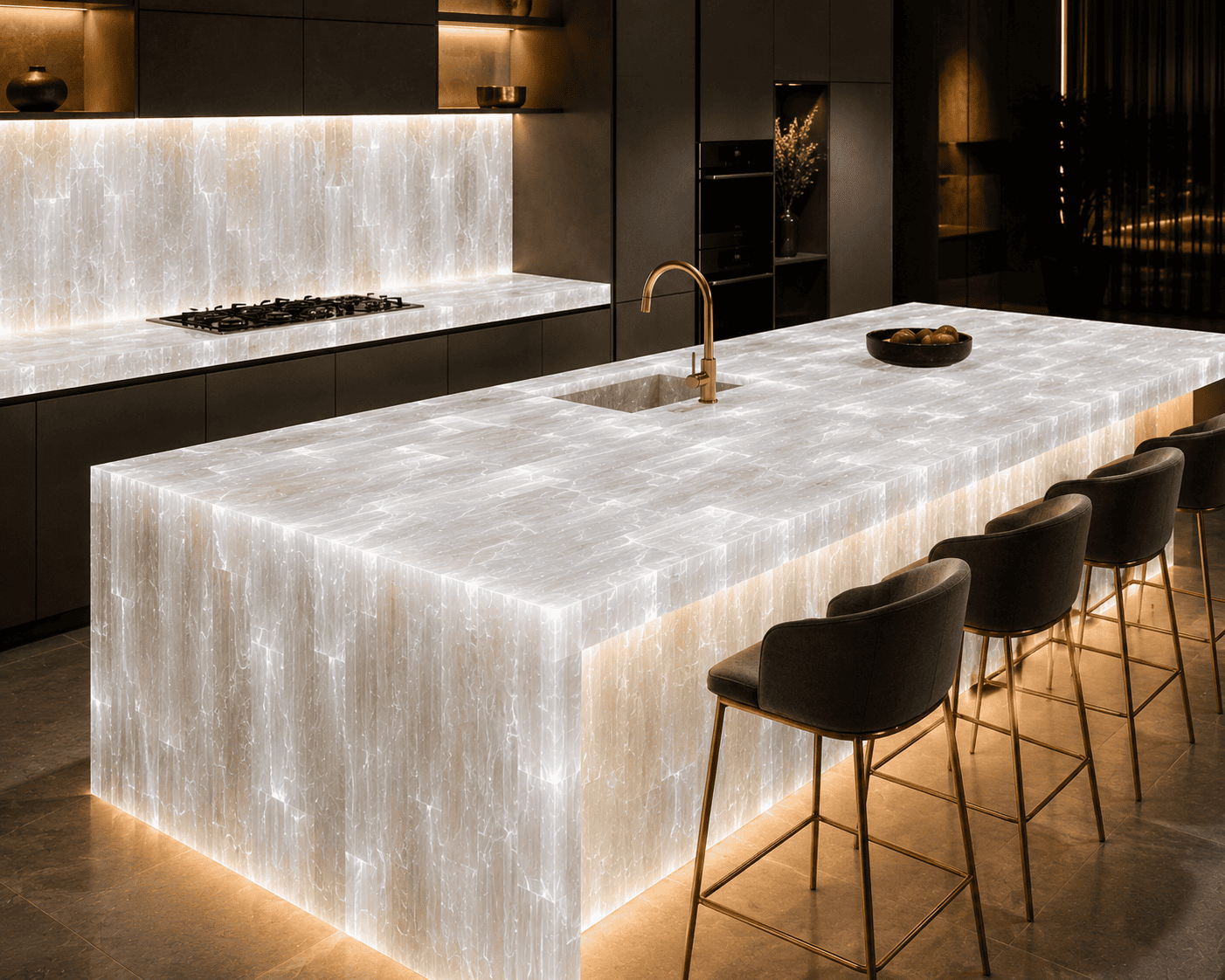
For kitchen islands, selenite is best used as a backlit accent panel on the side or base of the island rather than the working top itself. This keeps the glowing visual impact of the stone while directing daily wear to a more durable surface.
Selenite Bathtub
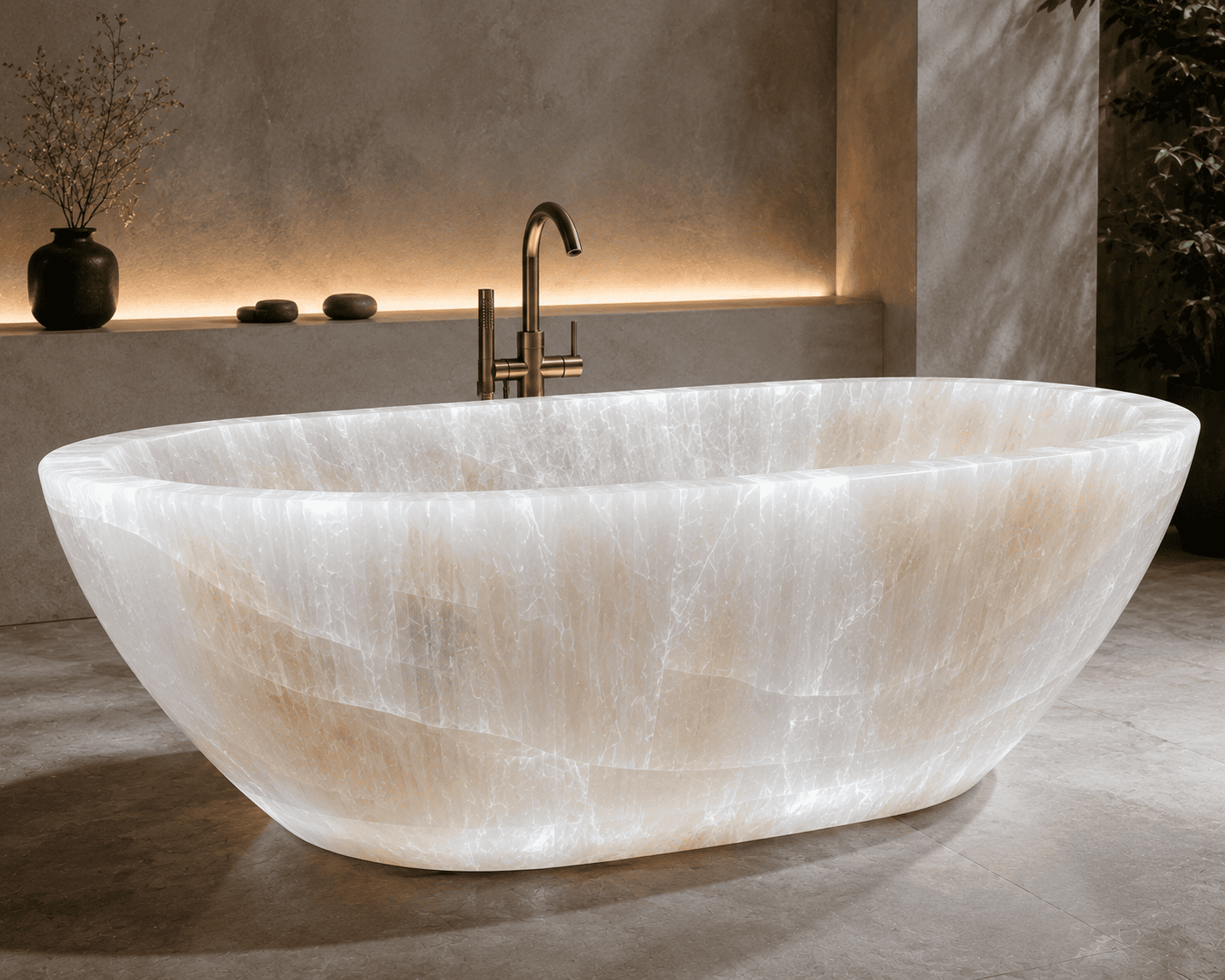
Selenite panels installed as a backlit surround behind a freestanding bathtub create a spa like glow that has become popular in boutique hotel suites. We do not recommend selenite as the bathtub basin itself, since prolonged water contact is not suitable for this stone.
Selenite Wall Highlighter
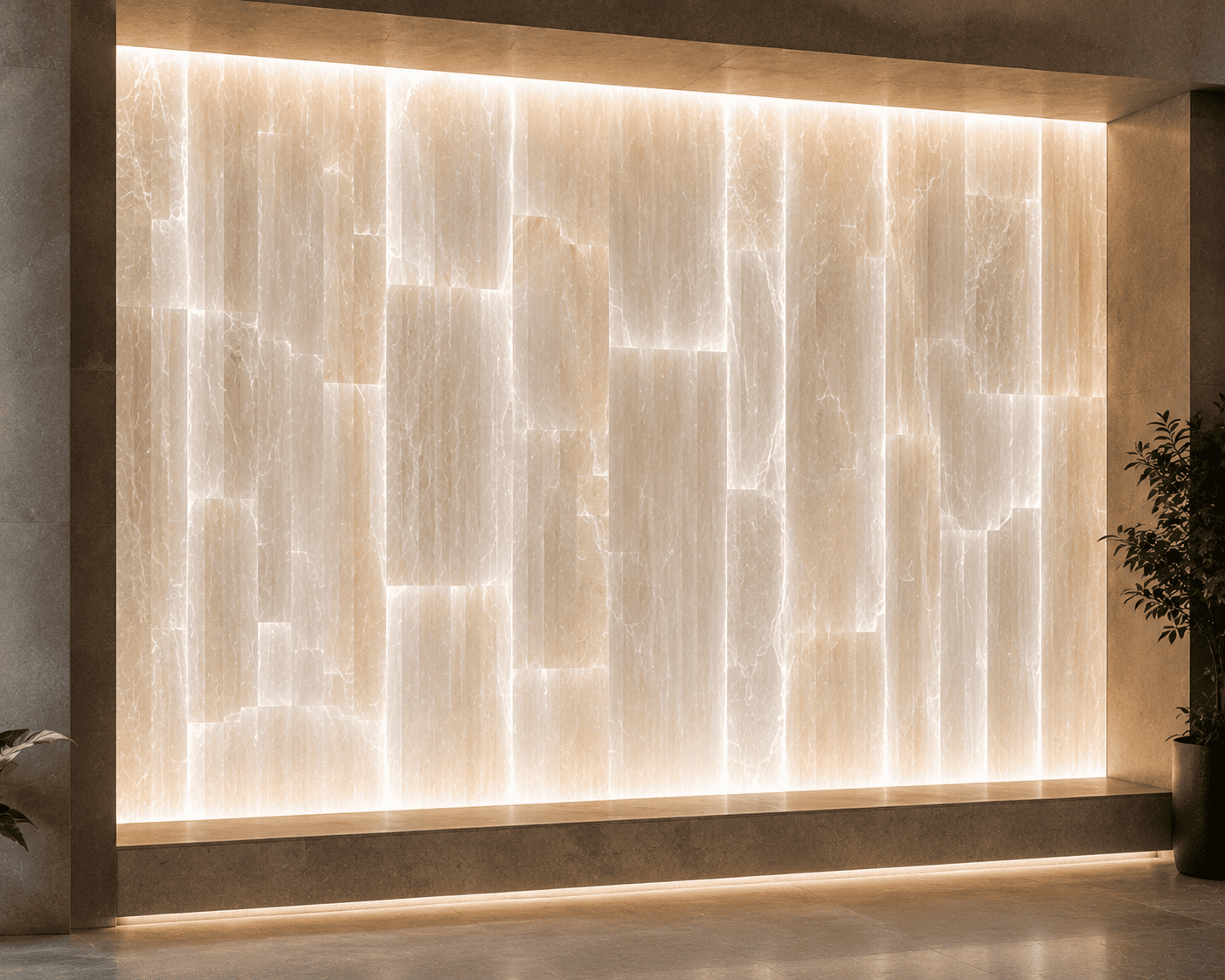
This is the signature application for selenite slab. A full height backlit selenite wall highlighter installed against a recessed LED panel produces a soft, even, moon like glow across the entire surface, making it the most requested use of this stone among our export clients.
Selenite in Living Room Interiors
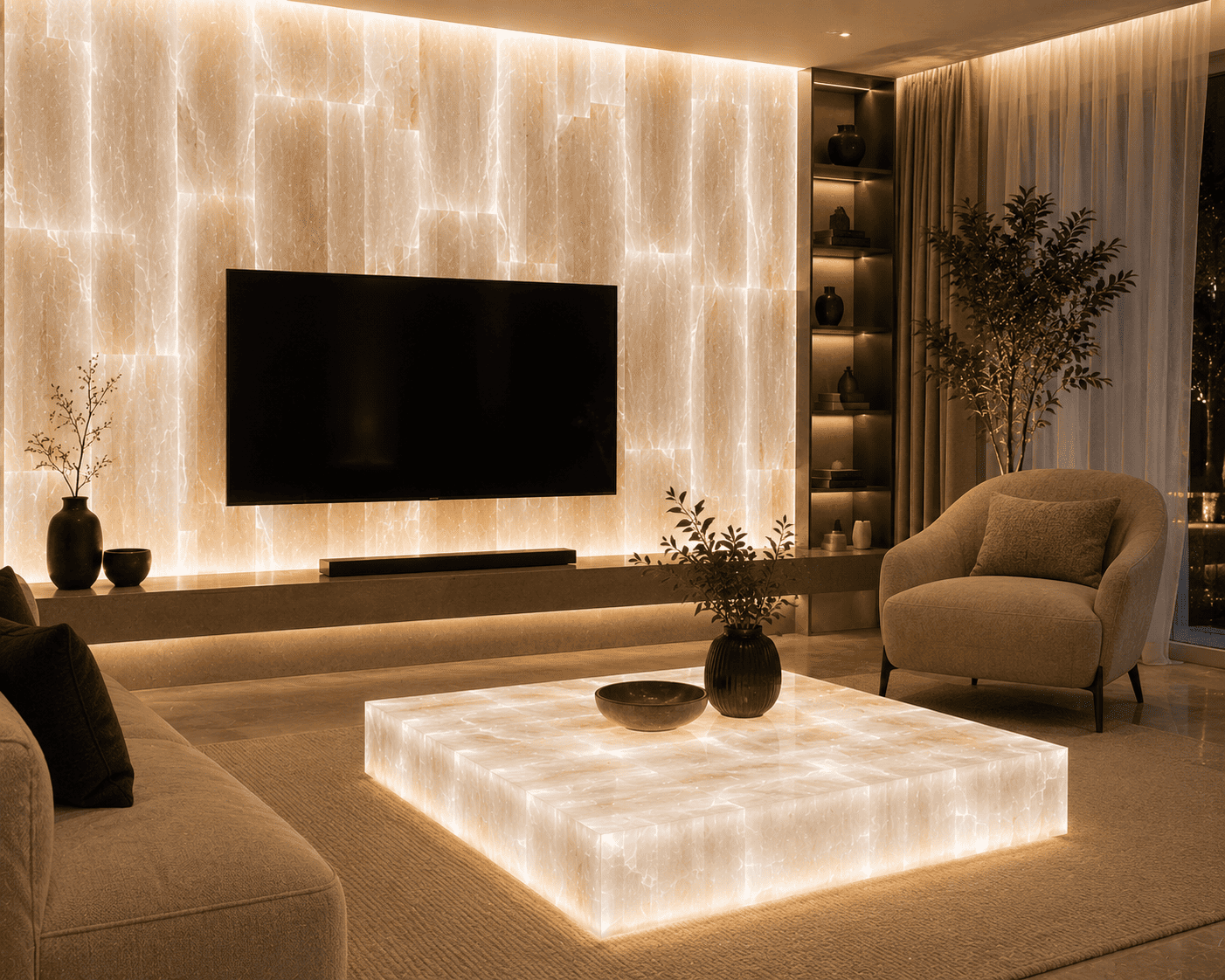
In living rooms, selenite is commonly used as a backlit accent wall behind a television unit or seating area, or as a smaller illuminated feature panel that draws the eye without overwhelming the space.
Selenite Dining Table
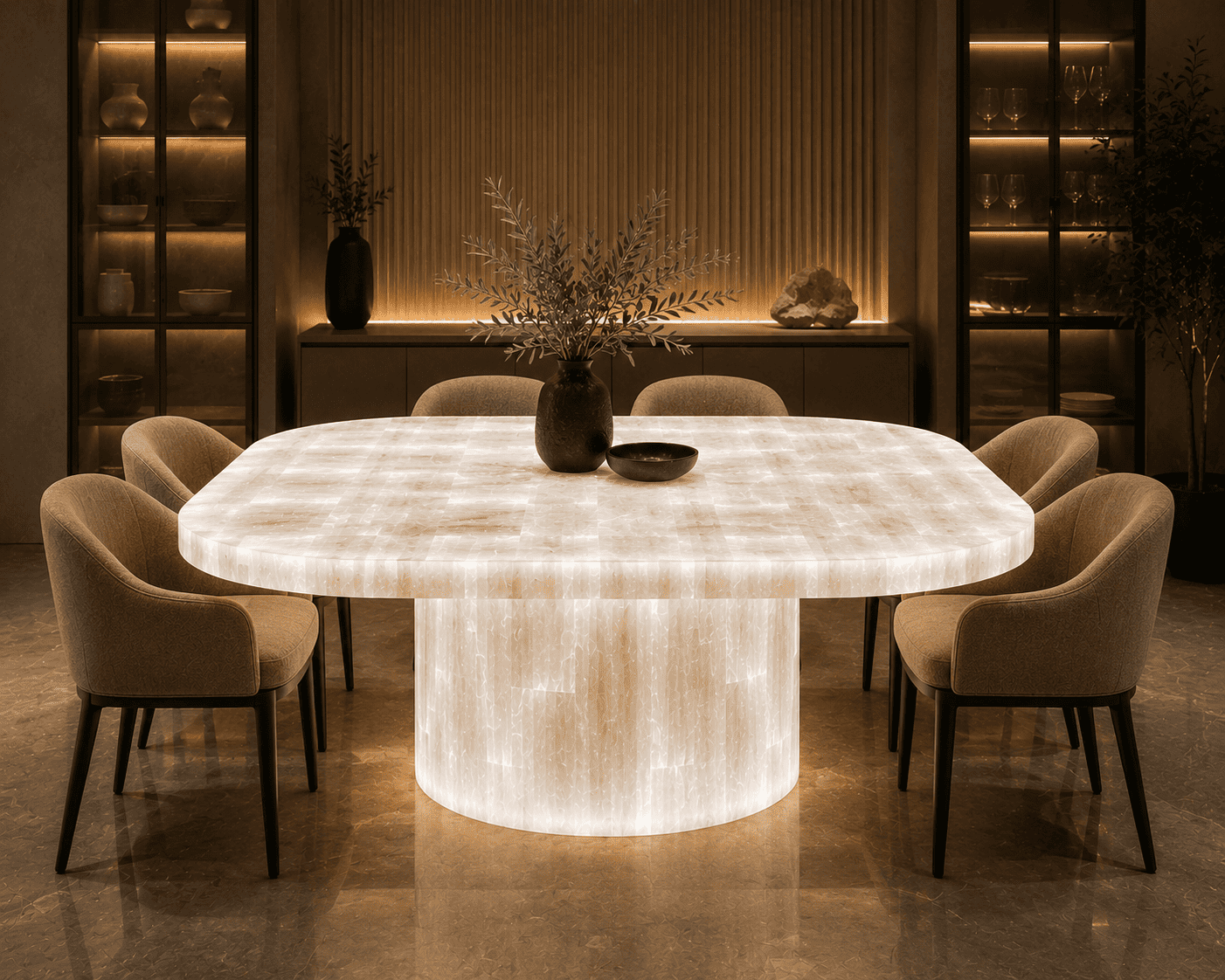
A statement selenite dining table top, sealed and backlit from a hidden base, can serve as a striking centrepiece for formal dining rooms. Because of the stone’s softness we recommend this only with a protective sealant and light day to day use.
Selenite Center Table and Round Table
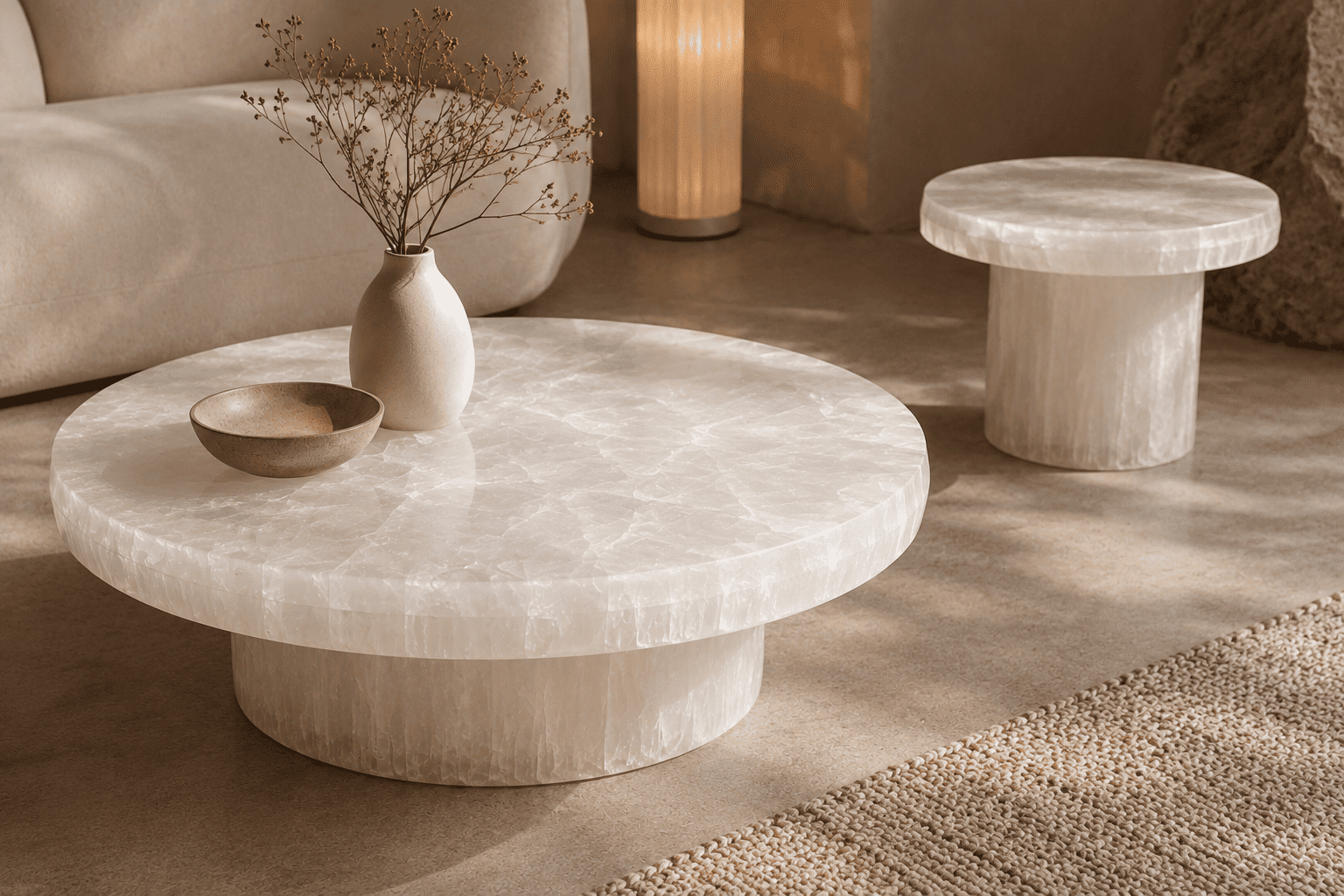
A round selenite top is a popular choice for center tables, since the circular format highlights the natural veining and glow of the stone evenly from every angle when lit from below.
Selenite Wash Basin
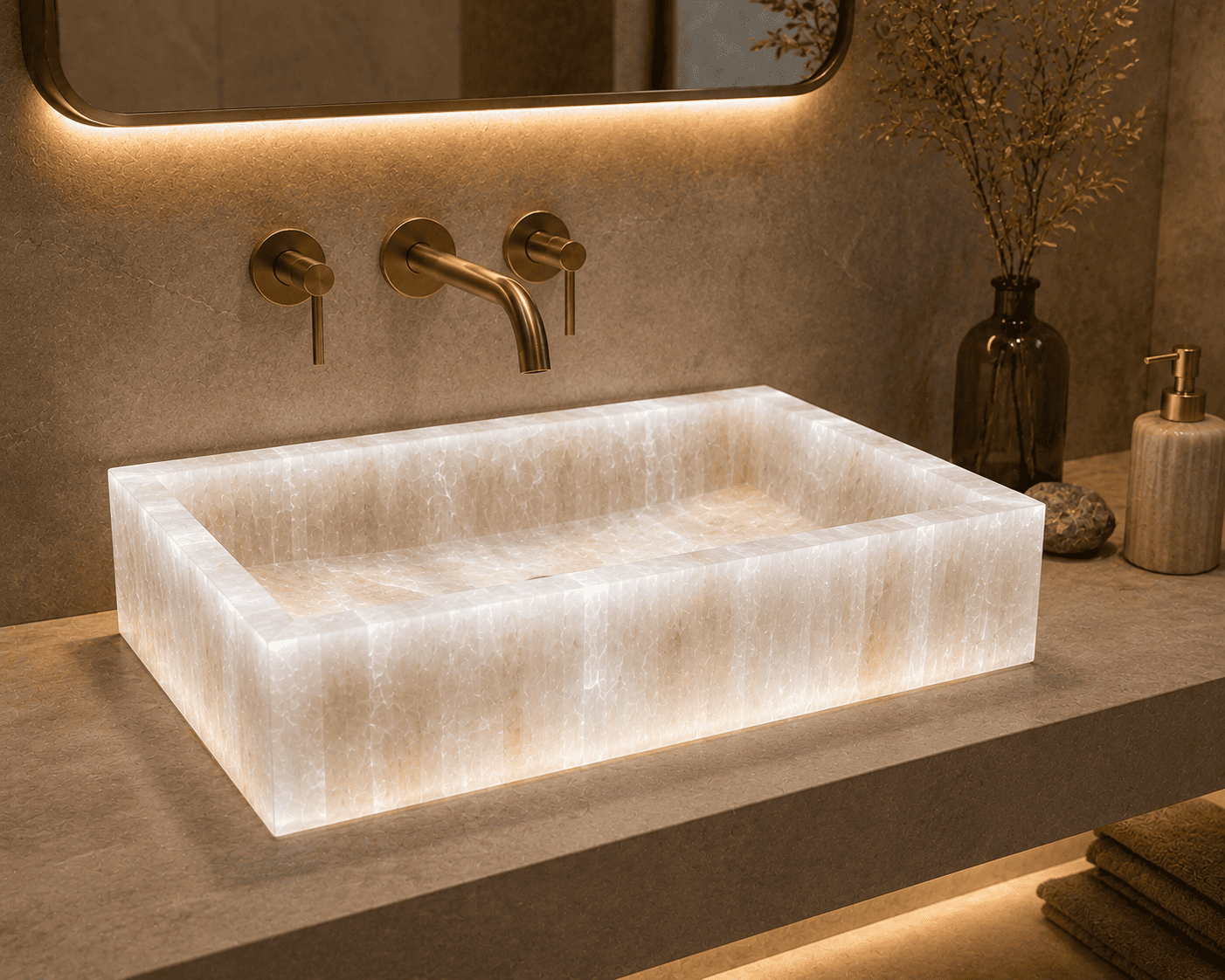
A selenite wash basin works best as a decorative vessel basin with a sealed interior, rather than a basin exposed to constant standing water. Backlighting the basin base is a distinctive design detail that several of our hospitality clients have specified for powder rooms.
Selenite Inlay Work
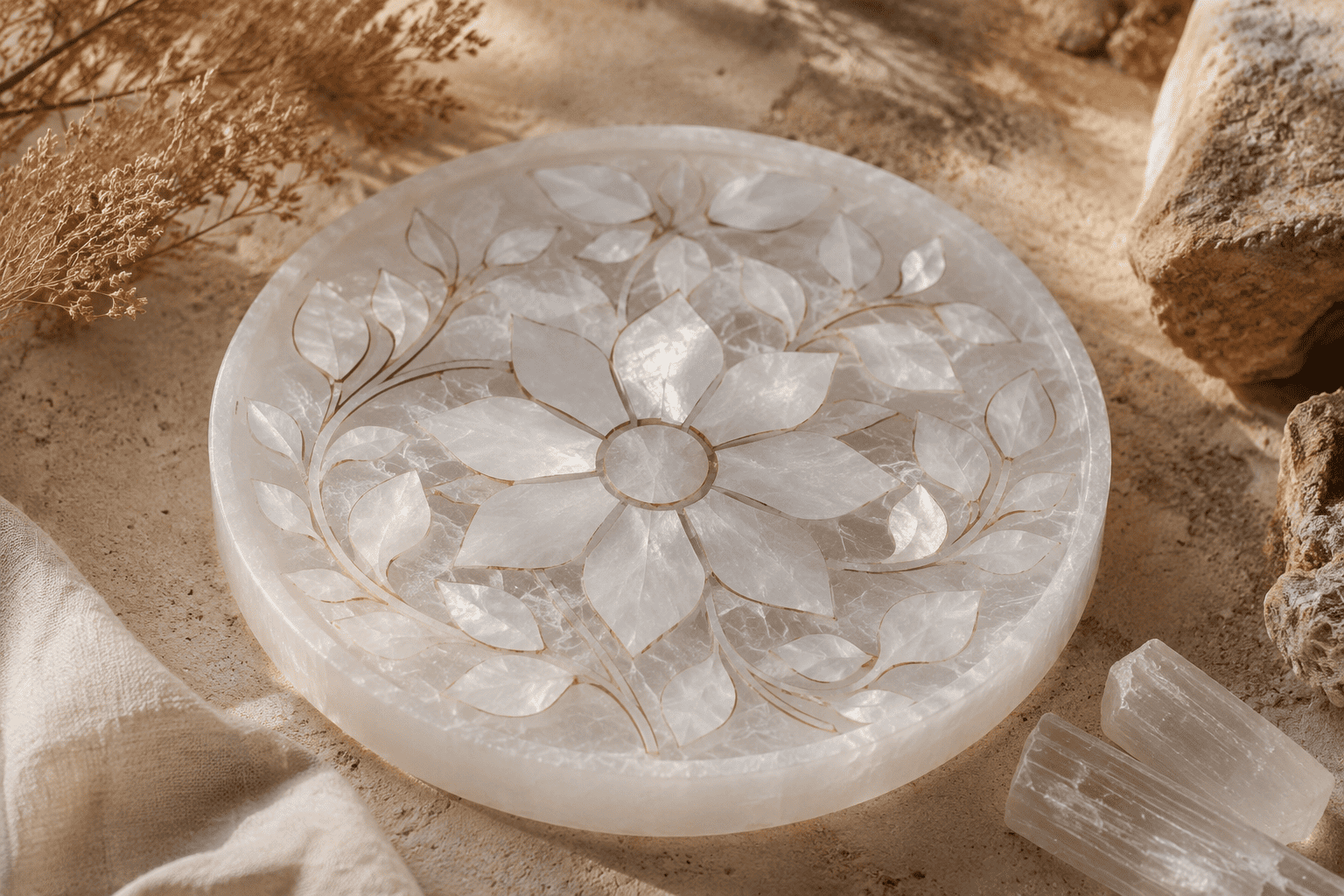
Selenite is well suited to inlay work, where thin cut pieces are set into doors, furniture panels or wall partitions and backlit to create a glowing pattern. This is one of the most design forward uses of the stone in luxury interiors.
Selenite Furniture
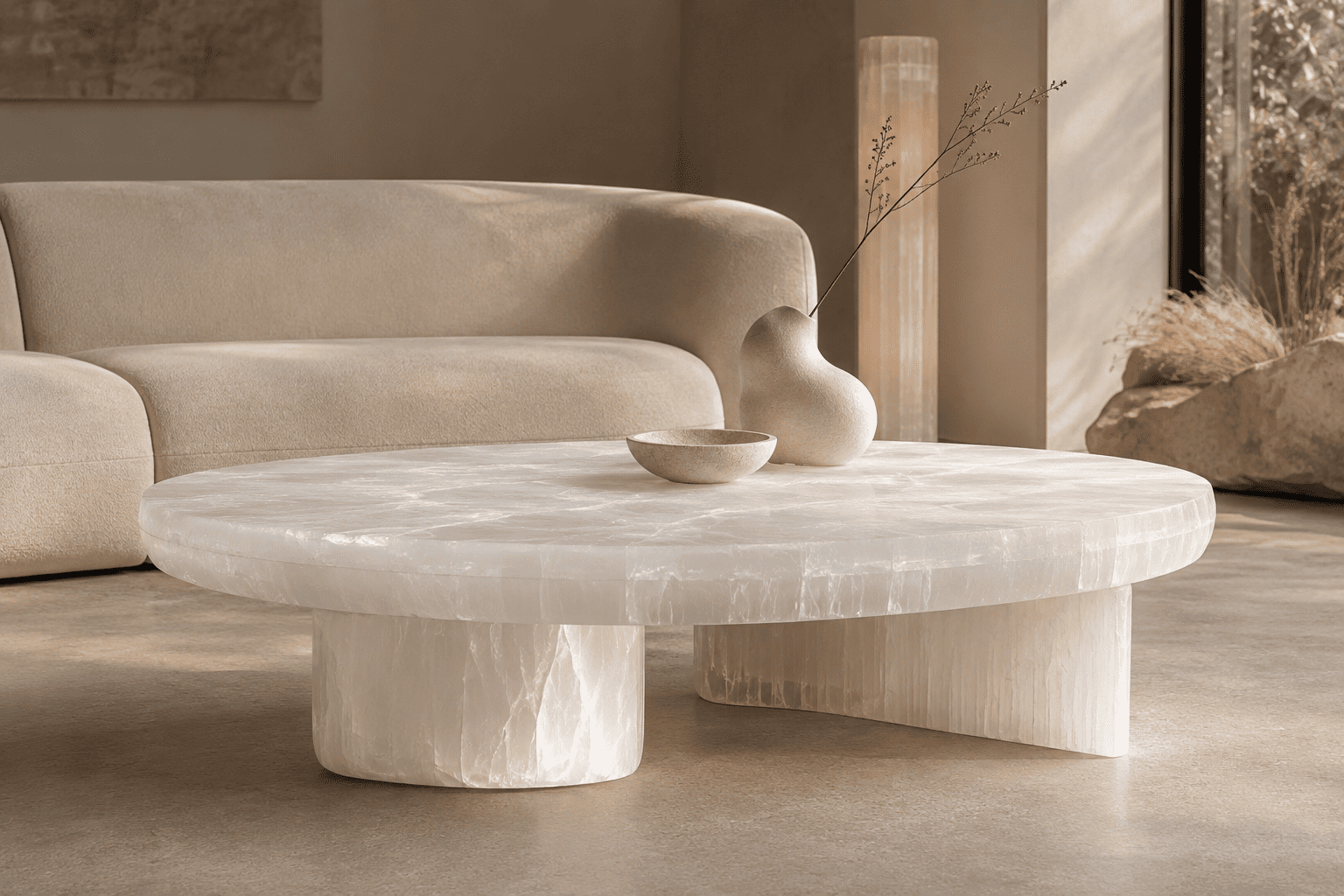
Beyond slabs, selenite is used in furniture accents such as cabinet fronts, a selenite door panel, or decorative screens, where the material’s glow becomes a functional light feature rather than a purely structural surface.
Selenite in Bathroom and Bathroom Vanities
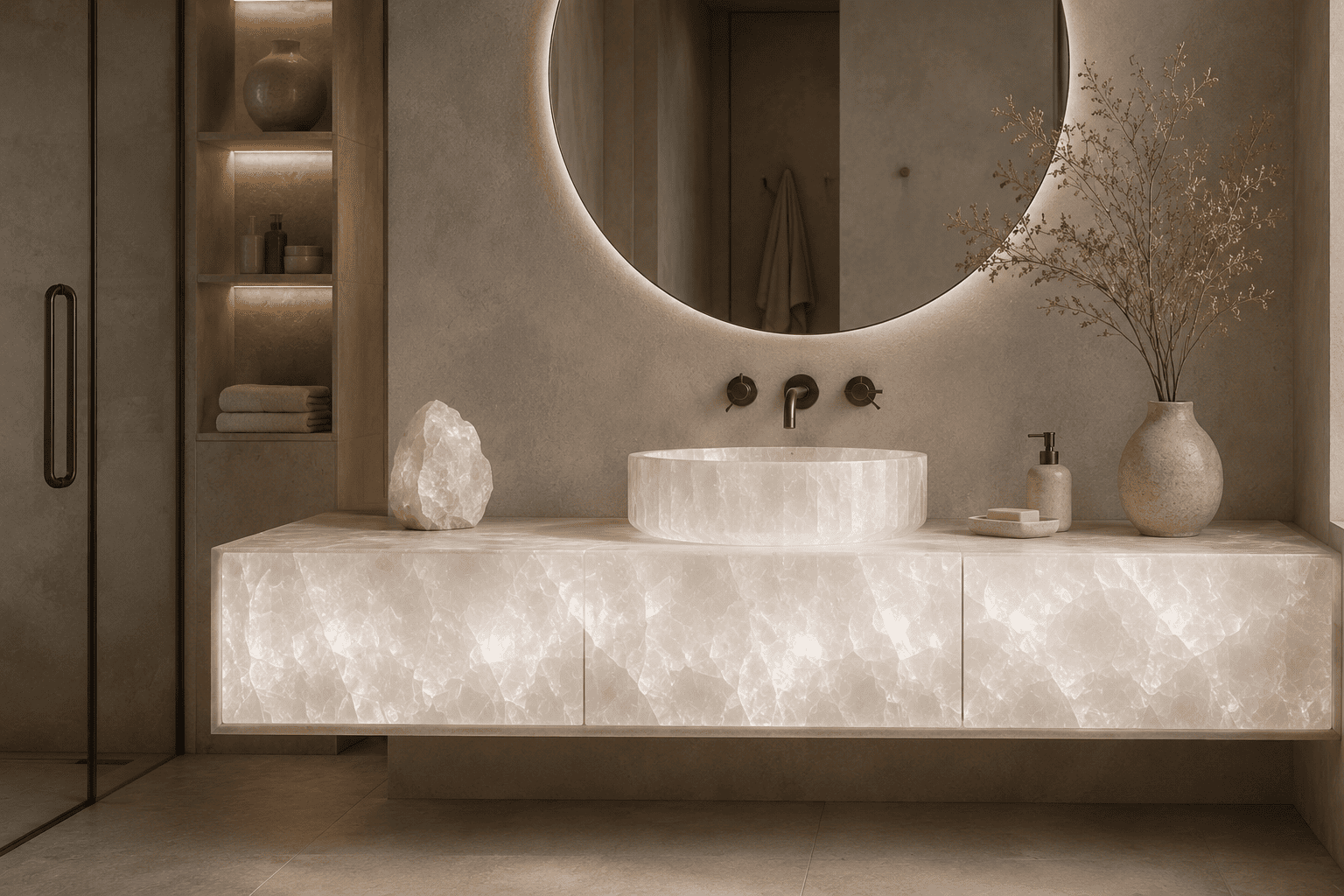
A backlit selenite panel behind a bathroom vanity mirror or along a feature wall creates a calming, spa like atmosphere. As with other wet area uses, we recommend selenite as an accent panel rather than the vanity top itself, given its softness.
Characteristics of Selenite Slabs
Understanding basic selenite slab properties helps buyers choose the right application. Selenite is composed of crystallised calcium sulfate dihydrate, giving it a soft, fibrous crystal structure and a Mohs hardness of only 2, well below granite or quartzite. This softness is directly responsible for its most valued property, a high degree of translucency that allows warm light to pass evenly through the stone.
Every selenite crystal slab is naturally formed, so no two panels are identical. Subtle variation in veining, tone and translucency is expected and is part of what makes each installation unique rather than a manufacturing defect.
Selenite Slab Benefits in Interior Design
- Produces a soft, even, moon like glow when backlit, unlike most other natural stones
- Lightweight relative to marble and granite, which simplifies wall and ceiling installation
- Works well as a room divider or partition that allows light through while preserving privacy
- Available in smooth, brick, round and raw formats to suit different design languages
- Each slab is naturally unique, giving every installation a one of a kind character
Is Selenite Slab Real or Fake?
Genuine natural selenite has a few identifying traits that imitation acrylic or resin panels do not share. Real selenite feels noticeably cool to the touch and has a soft, slightly fibrous surface, while it also shows natural, irregular veining and minor density variation across a panel rather than a perfectly uniform pattern. It is also considerably softer than glass or acrylic, and can be lightly scratched with a fingernail in an inconspicuous area, which synthetic alternatives will not allow. Every slab supplied by Subh Gem Stones is natural quarried selenite.
What is Selenite Slab Good For?
Selenite slab is best suited to backlit feature walls, ceiling panels, partition screens, inlay work and decorative accents in living rooms, bathrooms and hospitality interiors. In crystal healing traditions it is also associated with selenite benefits such as mental clarity and calm, which is part of why it is frequently specified for meditation rooms, yoga studios and spa treatment spaces alongside its visual appeal.
Is Selenite a Lucky Stone?
In many spiritual and crystal healing traditions, selenite is regarded as a stone of clarity, calm and positive energy, and is sometimes described as bringing good fortune to a space. These associations are part of traditional belief systems rather than scientific claims, but they are a significant reason selenite is chosen for homes, wellness spaces and hospitality interiors in addition to its architectural qualities.
Book or Send Inquiry for Selenite Slabs
Ready to move forward with your project? Send us your slab dimensions, preferred finish and application, and our team will respond with pricing and lead time.
- Phone: +91 9468720301, +91 8955298811, +91 8233202376
- WhatsApp: +91 89552 98811
- Email: info@subhgemstones.in
Frequently Asked Questions
1. What is a selenite slab?
A selenite slab is a natural translucent panel cut from crystallised gypsum. It is best known for the soft, moon like glow it produces when backlit with LED lighting, which makes it a popular choice for feature walls and decorative panels.
2. Is selenite slab suitable for countertops?
A full selenite slab is not recommended as a primary kitchen or bathroom countertop because its Mohs hardness of 2 makes it prone to scratching and moisture damage. It is better suited to backlit walls, ceiling panels, inlay work and other decorative uses.
3. What is the selenite slab price?
Selenite slab price depends on the slab size, thickness and finish you choose, along with whether you select the smooth panel or the selenite brick pattern. Contact our team on WhatsApp or email for current pricing and a formal quote.
4. What is the difference between selenite and selenite brick?
Selenite is a smooth, polished translucent panel, while selenite brick is a textured, dimensional slab cut into a brick like pattern for accent wall installations. Both are available in custom sizes from our Kishangarh facility.
5. Can a selenite slab be used outdoors?
Selenite is not recommended for outdoor installations. Its softness and water sensitivity mean it performs best in protected, climate controlled indoor environments such as feature walls, ceilings and interior partitions.
6. What thickness is recommended for a backlit selenite wall?
For maximum light transmission we recommend a thickness of 10 mm to 15 mm. For larger structural panels that need additional support, a thickness of around 20 mm is generally used.
7. Is selenite considered a lucky or healing stone?
In many crystal healing traditions, selenite is associated with mental clarity, calm and positive energy, and is sometimes referred to as the stone of love and clarity. These are traditional beliefs rather than scientific claims, and many customers choose selenite for this symbolism as well as its visual appeal.
8. How do I clean and maintain a selenite slab?
Wipe the surface gently with a soft, dry or slightly damp cloth. Avoid prolonged water exposure, acidic cleaners and abrasive scrubbing, since these can affect the surface of the stone over time.
9. Does Subh Gem Stones export selenite slabs internationally?
Yes. Subh Gem Stones manufactures selenite slabs at our facility in Kishangarh, Rajasthan and exports to buyers across 25 or more countries, with custom sizing and export documentation support available for every order.
10. What sizes are available for large selenite slabs?
We produce large selenite slabs as well as round and custom cut formats to suit feature walls, ceiling panels, table tops and inlay projects. Reach out with your project dimensions and we will confirm availability and lead time.